
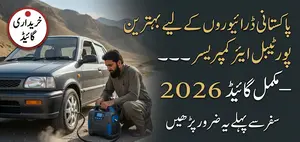
How to Pick Best Portable Car Air Compressor that won’t fail you in the middle of a scorching 45°C summer day on the Lahore-Islamabad Motorway, you need to look beyond the cheapest options available online.
Finding a reliable, high-performance tire inflator requires matching the compressor’s PSI rating and inflation speed to your specific vehicle type, whether you drive a compact hatchback like a Suzuki Alto or a heavy-duty 4×4 like a Toyota Hilux.
By prioritizing essential features like digital pressure gauges, automatic shut-off functionality, and robust thermal heat protection, you can transform a routine emergency roadside tool into a long-lasting investment that safeguards your fuel economy, extends tire lifespan, and ensures family safety on unpredictable roads.
Best Portable Car Air Compressor for Pakistani Drivers: Complete Buying Guide (2026)
Most Pakistani drivers own the wrong compressor or none at all
- For hatchbacks and sedans, a 12V socket compressor with auto shut-off is enough
- For SUVs, Hilux, and Prado, you need 150 PSI minimum and heat protection
- Digital gauge + auto shut-off are non-negotiables, not optional extras
- A good unit costs PKR 3,000–6,000, a one-time buy that pays for itself the first time you use it
The Scenario Every Pakistani Driver Should Picture
You are on the motorway from Lahore to Islamabad.
It is 40°C outside. Somewhere near Kalar Kahar, the steering starts pulling heavily. You stop. The front tyre is soft, not fully flat, but dangerously low for highway speeds.
Read More: Things to Check While Selling Your Bike
The nearest petrol pump? 12 kilometres away.
This is the exact moment a portable air compressor stops being an “accessory” and becomes the most valuable thing in your boot.
Most Pakistani drivers either do not own one, or bought the cheapest option off Daraz without knowing what actually matters. This guide fixes both problems.
Why Pakistan’s Roads Make This More Important Than Anywhere Else
Pakistan’s roads are punishing. Rutted city streets, sharp GT Road gravel, and extreme temperature swings all accelerate tyre wear and pressure loss.
Here is a fact most drivers do not know:
- Tyre pressure drops 1–2 PSI for every 5°C drop in overnight temperature.
- In a country where temperatures swing from 15°C at night to 42°C during the day, your tyres can be dangerously underinflated by morning without a single puncture occurring.
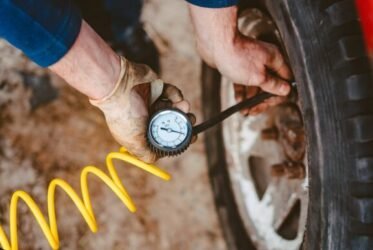
The consequences are real:
- A tyre just 6 PSI below recommended pressure loses 25% of its lifespan
- Underinflated tyres increase fuel consumption noticeably
- Braking distances get significantly longer, a life-safety issue on motorways
The fix is simple, cheap, and fits in your boot.
The 8 Things That Actually Determine a Good Buy
1. PSI Rating — Match It to Your Specific Vehicle
PSI (pounds per square inch) measures tyre pressure. Every car has a recommended PSI, usually printed on a sticker inside the driver-side door jamb or on the fuel cap flap.
Here is where Pakistani cars fall:
| Vehicle Type | PSI Range Needed | Common Examples |
| Small hatchbacks | 28–32 PSI | Suzuki Alto, Wagon R, Cultus |
| Sedans | 30–35 PSI | Honda City, Corolla, Yaris |
| Crossovers & SUVs | 33–38 PSI | KIA Sportage, Hyundai Tucson |
| Pickups & large 4x4s | 35–45 PSI | Toyota Hilux, Land Cruiser, Prado |
- The most common buying mistake: Purchasing a 100 PSI unit for a Hilux or Prado. It will struggle or fail mid-inflation. For large SUVs and pickups, 150 PSI minimum is non-negotiable.
- ⚠️ Watch out for this: Compressor boxes often advertise “max output PSI.” What actually matters is whether the unit can sustain your required pressure throughout a full inflation cycle, not just spike at peak for a second.
2. Inflation Speed — Critical on a Dark Highway
- Inflation speed is measured in litres per minute (L/min). Higher means faster.
- A standard passenger car tyre holds roughly 30–40 litres at normal pressure. At 15 L/min, that is a 2–3 minute fill. At 8 L/min, you are waiting 5+ minutes per tyre, crouched beside the road while trucks pass at 120 km/h.
Quick reference:
| Driving Pattern | Recommended Speed |
| City driving only | 10–15 L/min |
| Motorway / long routes | 20–30 L/min |
| SUV or heavy vehicle | 35+ L/min |
3. Power Source — The Decision Most Buyers Get Wrong
There are three types. Each suits a different driver profile.
- 12V Cigarette Lighter Socket The most common type. Plug in, attach nozzle, inflate. No charging needed.
- Watch out for: cable length. Many budget models come with a 3-metre cable that cannot reach rear tyres on a standard sedan. Always check for 3.5 metres minimum, 5 metres is ideal.
- Battery-Powered Cordless (Lithium-Ion) No cables, no fuss. Modern 20V+ models are fast and genuinely capable. The one catch: if you forget to charge it, it is useless exactly when you need it most. Plug it in at home weekly.
- Direct Battery Clamp Connects straight to the car battery like jumper cables. Draws more power, inflates faster, handles large tyres with ease.
- Best for: Prado, Land Cruiser, Hilux, and anyone doing northern areas off-roading.
Our honest recommendation for most Pakistani drivers:
A 12V socket compressor with at least a 3.5-metre cord covers 80% of needs. SUV owners and frequent northern highway travellers should invest in a clamp-type or cordless model instead.
4. Auto Shut-Off — Not a Luxury. A Necessity.
- Auto shut-off lets you preset your target PSI. The compressor inflates and stops the moment that pressure is reached.
- Without it, you are guessing. And overinflated tyres are actually more dangerous than underinflated ones at high speeds, the reduced contact patch cuts grip, and the stiff ride on Pakistani broken roads becomes punishing.
- Rule of thumb: If you are a first-time buyer or not mechanically experienced, only consider compressors with auto shut-off. Full stop.
5. Heat Protection — Pakistan’s Summer Tests Every Component
This is the most overlooked spec on every product listing, and it matters most in Pakistan.
Budget compressors heat up fast. In 45°C ambient temperatures, filling even one tyre can push a cheap unit beyond safe operating limits.
Most budget models are rated for 10–15 minutes of continuous use before needing a 20–30 minute cooldown. Some shut off mid-inflation. Others burn out permanently.
What to look for:
- A stated continuous duty cycle on the product specs
- A thermal protection cutoff that shuts the unit down safely rather than burning the motor
- Metal housing rather than all-plastic, metal dissipates heat significantly better
If you live in Karachi, Multan, interior Sindh, or southern Punjab, heat tolerance should be at the top of your checklist, not at the bottom.
6. Gauge Type — Digital Wins Every Time
Picture this: reading an analog gauge on a vibrating compressor, in bright Karachi sunlight, while kneeling on a road surface hot enough to burn your hands.
A 2 PSI misread is not minor when your recommended pressure is 32 PSI.
Digital gauges are clearer, more accurate, easier to read in all lighting conditions, and integrate far better with auto shut-off systems.
Buy digital unless you are on an absolute budget constraint.
7. Hose and Cable Length — Measure Before You Buy
The single most complained-about problem with portable compressors — and the easiest to avoid.
Minimum specs to look for:
| Component | Minimum | Better |
| Power cable | 3.5 metres | 5 metres |
| Air hose | 60 cm | 90 cm+ |
Real-world check: on a Toyota Corolla parked with the front against a wall, reaching the rear passenger tyre with a 2.5-metre cable and a 50 cm hose is nearly impossible. Many buyers only discover this the first time they actually need the product.
8. Bonus Features That Genuinely Add Value
- Built-in LED light — Sounds minor until you have a tyre issue at 2 AM on the Lahore Ring Road. A light that illuminates the valve area (not just points forward) is a genuine safety feature.
- Multiple nozzle attachments — Standard car tyre nozzle, bicycle adapter, and sports ball needle. More useful than most buyers expect.
- Carrying case or bag — Keeps fittings from getting lost in the boot and protects the unit from the Pakistani summer heat when not in use.
- Pressure release valve — Lets you bleed off pressure if you over-inflate. Particularly useful for first-time users.
Quick Decision Table — Find Your Match in 10 Seconds
| Your Situation | What to Buy |
| Hatchback, city driving only | 12V socket, 100 PSI, digital gauge, auto shut-off |
| Sedan, occasional motorway | 12V socket, 120 PSI, 4m+ cable, auto shut-off, LED |
| SUV or crossover | 12V or cordless, 150 PSI+, 30+ L/min, heat protection |
| Pickup / heavy 4×4 / off-road | Direct battery clamp, 150+ PSI, fast inflation |
| Frequent long-route traveller | Cordless lithium-ion, always keep charged |
Bonus: What to Check on a Second-Hand Car Before Buying
If you are inspecting a used car, add tyre condition to your checklist.
A portable air compressor helps you test whether a tyre holds pressure, a slow leak can mean a cheap plug repair or a damaged bead, but also look for:
- Uneven wear patterns Outer edge wear = previously overinflated. Inner edge wear = underinflation or alignment issues.
- Sidewall cracking Very common on Pakistani cars that sit in direct sun. Cannot be repaired — tyres must be replaced.
- Tread depth Push a matchstick into the tread groove. If the groove barely exceeds the matchstick head depth, those tyres need replacing soon.
- The spare tyre Always check. It is almost always ignored. A flat spare on a used car tells you a lot about how the seller maintained everything else.
A seller who has not maintained tyre pressure has likely not maintained other things either.
Frequently Asked Questions
Q1: Can a portable compressor fill a completely flat tyre?
Ans. Yes, but it stresses the unit heavily and takes much longer. If a tyre is fully flat (0 PSI), put on the spare first and use the compressor to top up a low tyre later. Filling from zero in summer heat will push budget compressors into thermal shutdown.
Q2: How often should I check tyre pressure in Pakistan?
Ans. Once a month at minimum, and always before a long trip. Check when tyres are cold, the car should not have been driven for at least two hours. Driving heats the air inside and gives a falsely high reading.
Q3: Is it safe to run the compressor with the engine on?
Ans. Yes. For 12V socket models, running the engine actually helps maintain stable voltage to the unit, particularly important for clamp-style models.
Q4: What PSI should I use for motorway driving?
Ans. Follow your car manufacturer’s recommendation, not general advice. Some manufacturers specify slightly higher pressure for sustained high-speed use. Check your owner’s manual, it is always the authoritative source.
Q5: My compressor is slow and keeps overheating. What is wrong?
Ans. The motor is almost certainly undersized for your tyre size, or the ambient temperature is pushing it past its rated duty cycle. A compressor that shuts down mid-inflation is worse than useless in an emergency. Upgrade to a higher-rated unit.
The Final Word
The right portable air compressor for Pakistan is not the most expensive one — and definitely not the cheapest.
It is the one that:
- Matches your vehicle’s PSI needs
- Works reliably in 45°C summer heat
- Has a long enough cable to reach all four tyres
- Has auto shut-off and a digital gauge
- Will actually be there, working, when you need it at the side of the road
Budget: PKR 3,000–6,000 for a quality unit is a one-time investment. It pays back the first time it saves you from a roadside scam, a dangerous drive on a soft tyre, or a 12-kilometre walk to the nearest pump.
Buy right once. Keep it charged. Check your pressures monthly.
How to Pick Best Portable Car Air Compressor that won’t fail you in the middle of a scorching 45°C summer day on the Lahore-Islamabad Motorway, you need to look beyond the cheapest options available online.
Disclaimer/Note: The information above might not be 100% correct. Please verify from your own sources. We will not be responsible for any kind of loss or liability due to our content.
For more news, please visit Munafa Marketing.