

ANZA 4 Air Defense System – All You Need To Know featuring 15 KM Range, 4 batteries, 360-degree protection, day & night operation, and 16 missiles.
ANZA-4: Pakistan’s New SHORAD Powerhouse – عنزا-4: پاکستان کے شارٹ رینج فضائی دفاعی نظام کا نیا شاہکار
The modern battlespace is undergoing a radical transformation. No longer defined solely by massive armored formations or high-altitude aerial dogfights, the threats today are smaller, stealthier, and highly dynamic.
Low-altitude challenges, including sophisticated drones, loitering munitions, combat helicopters, and precision rockets, have necessitated a revolution in Short Range Air Defense Systems (SHORAD).
Historically, Pakistan’s layered air defense has relied heavily on the indigenous Kahuta Research Laboratories (KRL) Anza Man-Portable Air-Defense Systems (MANPADS), the Mk-I, Mk-II, and Mk-III (the latter closely associated with Chinese QW technology), for point defense.
These infrared-homing systems provided low-altitude protection up to about 5-6 km.
Read More: Pakistan Air Force Day being observed today – 7th Sep
While officially verified details are tightly guarded, synthesized information from defense databases suggests the ANZA-4 is not merely an incremental update to the traditional MANPADS family, but an entirely new, vehicle-mounted evolution designed to dominate the modern SHORAD environment.
Note: It is important to mention that at the time of publishing, the information on Anza 4 System is quite rare. That is the actual details might differ in the future. Plz verify the information from your own sources.
The Legacy of Self-Reliance: Tracing the Anza MANPADS Pedigree
To truly appreciate the strategic leap that the ANZA-4 represents, one must examine the formidable legacy of the Anza weapon family within the Pakistan Armed Forces.
Developed by Kahuta Research Laboratories (KRL) starting in the late 1980s, the Anza series served as Pakistan’s foundational step toward self-reliance in low-altitude air defense, systematically evolving across three distinct generations to counter shifting regional threats.
1. Anza Mk-I: The Infantry Pioneer
- Introduced as Pakistan’s first indigenous man-portable air defense system (MANPADS), the Anza Mk-I was engineered with technical insights derived from the Chinese HN-5 series (historically linked to the Soviet Strela-2).
- Featuring a basic tail-chase infrared homing seeker, it provided frontline infantry units with an organic, low-altitude defense umbrella against low-flying targets up to a range of 4.2 km.
- While technologically modest by today’s standards, it successfully established Pakistan’s domestic missile manufacturing, testing, and fueling infrastructure.
2. Anza Mk-II: The Combat-Proven Workhorse
- The introduction of the Anza Mk-II in the mid-1990s marked a major qualitative jump, adopting technology from the Chinese QW-1 family.
- The Mk-II brought all-aspect targeting capabilities, allowing infantry teams to lock onto incoming aircraft head-on rather than merely chasing tailpipe heat.
- Armed with enhanced Infrared Counter-Countermeasures (IRCCM) to bypass enemy decoy flares, its range expanded to 5 km with a maximum speed of Mach 2.
- The system earned historic combat validation during the 1999 Kargil conflict, where it was deployed to intercept intruding combat aircraft, successfully downing an Indian Air Force MiG-21 fighter jet and a Mi-17 helicopter.
- This engagement cemented the Anza’s reputation as a highly lethal and reliable battlefield asset.
3. Anza Mk-III: The Multi-Band Digital Shield
- Entering service to bridge the gap into the 21st century, the Anza Mk-III adapted technology from the advanced QW-2 lineage.
- It introduced a dual-band infrared/ultraviolet seeker, allowing the missile to distinguish between actual aircraft signatures and sophisticated thermal jamming environments.
- Boasting a digital firing unit, an improved proximity fuse, and an extended 6 km operational envelope, the Mk-III became the standard point-defense shield protecting Pakistan’s mechanized armor columns and sensitive strategic positions.
Integrating into the ANZA-4 Era
For over three decades, these shoulder-fired systems formed the bedrock of Pakistan’s low-tier air defense. However, the modern paradigm shift toward automated drone swarms and high-speed precision rockets meant that standalone, infantry-operated tubes had reached their physical structural limits.
The ANZA-4 represents the logical, modern culmination of this 30-year operational pedigree, scaling up the time-tested lethality of the Anza missile lineage from an isolated infantry weapon into a centralized, vehicle-mounted, and radar-guided SHORAD complex.
The Critical Extension: 15 KM Range
The most striking specification of the ANZA-4 is its purported operational range of 15 KM.
Traditional low-altitude MANPADS rarely exceed 6 km in effective range. A jump to 15 km is a paradigm shift. This means the ANZA-4 is transitioning from a traditional “point defense” weapon to a “local area defense” system.
A 15 km bubble provides critical protection not just for individual convoy assets, but for forward operating bases and crucial infrastructure.
Crucially, this extended range allows the system to target attack helicopters and stand-off capable drones before they can release their own precision-guided munitions, thereby addressing the “stand-off threat” that traditional Anza variants struggled to neutralize.
Vertical Dominance: 60,000 Feet Ceiling
Complementing its horizontal range is the ANZA-4’s stated altitude ceiling of 60,000 feet.
This capability is unexpected for a system born from a MANPADS lineage (the Mk-III, for instance, had a ceiling of roughly 4,000 meters or 13,000 feet).
A 60,000-foot ceiling moves the system from merely low-altitude protection to medium-altitude capability.
This puts the ANZA-4 in a class where it can effectively intercept not just low-flying helicopters, but also medium-altitude long-endurance (MALE) ISR (Intelligence, Surveillance, Reconnaissance) UAVs and jet aircraft trying to operate above standard MANPADS reach.
It fills a crucial gap between MANPADS and heavier, longer-range systems like Pakistan’s existing HQ-7B or FM-90 batteries.
Supersonic Response: Mach 2.5 Speed
In modern warfare, where seconds matter, speed is essential. The ANZA-4 missile is reported to achieve a velocity of Mach 2.5 (approximately 1,900 mph).
This high supersonic speed is not just about interception efficiency; it is about reaction time. A Mach 2.5 missile severely reduces the available reaction time for enemy pilots, helicopter countermeasures, or drone collision avoidance systems. When integrated with advanced sensors, this speed allows the ANZA-4 to engage fast-moving aerial targets and even high-speed precision guided rockets.
Firing Platform: Mobile Pickup-Based, 16 Missiles Ready
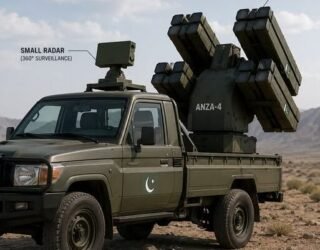
The integration strategy for the ANZA-4 is equally significant: it is a Mobile Pickup-Based Platform.
Unlike heavy, armored anti-aircraft vehicles, mounting the SHORAD system on a highly mobile tactical pickup truck provides several asymmetric advantages.
This configuration ensures extreme high mobility and rapid deployment, allowing the system to keep pace with fast-moving convoys or navigate rugged Pakistani terrain, such as the deserts of Balochistan or mountainous border regions, where heavier platforms might struggle.
The platform is designed to carry a staggering 16 missiles ready-to-fire. This massive fire volume allows a single tactical unit to manage complex engagement scenarios, such as saturated drone swarm attacks or multi-target helicopter assaults, without requiring an immediate, vulnerable reload sequence.
Integrated Surveillance: 360° Radar and All-Weather Capability
Moving beyond the MANPADS dependence on optical or limited infrared detection, the ANZA-4 is described as an integrated complex featuring 360° Radar Surveillance.
A light, rotating surveillance radar integrated into the pickup-mounted platform provides authentic All-Weather, Day and Night capability.
This sensor suite allows the system to operate autonomously to detect, track, and provide fire-control solutions against low-observable targets like drones, even in visibility-reducing conditions like heavy fog or dust storms common in Southwest Asia. It elevates the ANZA-4 from a purely reactive system to a proactive battlefield guardian.
Factual Accuracy and Context
It is vital to contextually analyze the ANZA-4’s specifications. While the listed specifications (15km range, 60,000 ft altitude) are highly impressive, they represent a conceptual jump from traditional low-altitude MANPADS.
Our analysis, the ANZA-4 is likely Pakistan’s indigenous bridge solution.
It combines advanced infrared homing guidance (likely derived from Anza Mk-III/QW lineage) with modern solid-fuel rocket technology and radar sensors, integrated into a tactically nimble, cost-effective platform to counter the highly specific 21st-century threats facing Pakistani forces.
Conclusion: ANZA 4 Air Defense System – All You Need To Know
The emergence of the ANZA-4 concept, defined by its 15km range, supersonic speed, medium-altitude reach, and highly mobile 16-missile tactical platform, represents a major milestone in Pakistan’s indigenous defense modernization. While detailed operational capabilities remain classified, analyzing the technical specifications highlights a system designed to address the most dangerous and complex challenges of modern low-altitude warfare. It promises to be a vital, asymmetric asset, reinforcing Pakistan’s layered air defense network with unprecedented mobility and reactive power.
This piece of information is based on the available information. Believing in this blog is completely your responsibility.
Disclaimer/Note: The information above might not be 100% correct. Please verify from your own sources. We will not be responsible for any kind of loss or liability due to our content.
For more news, please visit Munafa Marketing.