Strait of Hormuz – All You Need to Know in 2026 will surely be informative and an eye-opener for your knowledge.
Strait of Hormuz: Why This Geopolitical Choke Point Is Also a Surreal World of “Unreal” Beauty
Think you know the Strait of Hormuz?
If you only follow the headlines, you likely see it as a tense coordinate on a map. A suffocating “choke point.” A place where global energy security hangs by a thread.
You picture gray warships and massive oil tankers playing a high-stakes game of chicken.
And, especially recently, that image has felt terrifyingly accurate. The ongoing regional conflicts that intensified in the mid-2020s have repeatedly centered on this narrow passage, sending shockwaves through global markets and keeping the world on edge.
The threat of closure, whether from military action or political leverage, is a constant, suffocating reality.
But that is only the version the world has been shown.
What if I told you that this same strip of salt-scorched land, where summer temperatures can “melt human will”, was the center of imperial ambition for centuries?
Read More: Islamabad Accord – Peace of the Century
What if I told you that renowned explorers, from Marco Polo to Alfonso de Albuquerque, risked their lives just to set foot here?
Hormuz is not a dry military outpost. It is “Unreal Hormuz”, a surreal civilization where nature and history collide to create something unlike anywhere else on Earth. It is a place that transforms extreme harshness into an art form.
The Geopolitical Dual Reality: Strait of Hormuz – All You Need to Know in 2026
This is the inescapable paradox of Hormuz. It is one of the most geologically theatrical terrains on the planet, yet it is inseparable from the narrow corridor of water that surrounds it.
This passage is barely 21 miles across at its tightest point. Through it flows the energy architecture of modern civilization, without pause or guarantee.
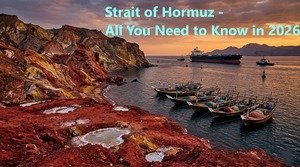
While below, supercarriers the length of four city blocks navigate shipping lanes barely two miles wide in each direction, carrying 20% of the world’s petroleum, about 21 million barrels daily.
Their wakes disturb the same iron-rich coastline where the island “bleeds” its red mineral runoff slowly into the Gulf. This dual reality, intimate landscape versus abstract global dependency, is the defining pulse of Hormuz.
The recent spike in tensions has only highlighted this. While the global conversation focuses on “strategic denial” and “freedom of navigation,” the local marine pilots and small-boat fishermen treat the passage as their working environment, defined not by symbolism but by current, draft, and the alertness required for daily survival.
Hormuz became this layered contradiction through scales operating across millions of years: the salt-dome tectonics that created its impossible colors, and the strategic twist of fate that formalized it as a global choke point.
Today, both pressures, the weight of global attention and the fragility of local resources, intensify simultaneously.
Nature’s Defiant Laboratory
If you want to understand resilience, look past the politics and look into the water.
The “Impossible” Coral Reefs: Strait of Hormuz – All You Need to Know in 2026
By most ecological measures, the Persian Gulf should be too hostile for coral reefs. In summer, water temperatures regularly hit a scorching 96°F. This is the temperature at which corals everywhere else experience mass bleaching and die.
Yet, the reefs around Hormuz and its peripheral islands not only survive; they thrive.
Through thousands of years of extreme thermal cycling, these corals have developed a heat tolerance that represents one of the most significant cases of adaptive evolution in modern marine biology.
They carry, encoded in their biology, the secrets to persisting where persistence should be impossible.
These reefs support more than 700 fish species, sustaining coastal communities across the entire northern Gulf Coast.
For local fishermen, their presence is not abstract; it defines where nets are set and where traditional grounds have been maintained for generations.
But even this incredible adaptation has its limits.
While the corals adapted over millennia, current threats, oil contamination from tanker traffic, runoff from rapid development, and regional military activity, are imposing pressures for which no biological adjustment exists.
Hormuz reminds us that survival is a mechanism, and mechanisms can be broken.
The Hara Forest: Nature’s Filter: Strait of Hormuz – All You Need to Know in 2026
Along the southeastern shoreline of Qeshm Island, another biological miracle quietly unfolds.
The Hara Forest, covering roughly 30 square miles, is a dense growth of Avicennia marina, a mangrove species that has solved a fundamental environmental contradiction: how to grow in water that would kill almost any other plant.
These “Har” trees filter salt through their root systems, expelling it through their leaves in visible crystals. Sustained by a mechanism refined over millions of years, they exist in near-total salinity.
For generations, the fishing communities have seen this forest not as a wilderness but as a production system. It is the Gulf’s nursery, generating the nutrient conditions that support shrimp and fish populations before they move into deeper waters.
This ecosystem, too, faces unprecedented threats. Oil contamination, warming waters, and extreme heat events endanger the nursery of the sea, and by extension, the food system upon which coastal communities depend for survival.
A Civilization Built on Survival, Not Abundance
To live in the Strait of Hormuz is to live according to an entirely different set of rules. Here, power is not measured by weapons but by the ability to endure under burning heat and maritime isolation.
Qeshm: The Organizing Principle of Heat
Qeshm is the largest island in the Persian Gulf, but it carries its 87-mile scale without grandeur. In summer, temperatures regularly exceed 115°F, and the humidity makes the air feel warm against the skin.
For its inhabitants, this extremity is the organizing principle of everything. Life does not follow the clock; it follows the sun.
Markets empty before the shade disappears. Activity concentrates in the pre-sunrise hours before the water begins to shimmer.
Houses are built not for show, but with thick walls for thermal mass, oriented precisely to capture the northwest wind. Water is managed with a discipline that has outlasted the scarcity that originally created it.
Loft and the Art of Ancient Engineering
Nowhere is this “technology of survival” more visible than in the village of Loft on Qeshm’s northwestern shore. Here, stacked houses of coral stone and mudbrick are defined by the iconic Badgir, ancient “wind towers.”
These structures, some over a thousand years old, are the perfected solution to a life-or-death problem: how to make a building survivable when the exterior air reaches 122°F.
Without electricity or machinery, these towers channel cooler air from above down through internal baffles, creating an interior temperature 15 to 20°F cooler than the outside.
Loft’s 366 ancient wells tell a parallel story. A water management system was designed so each well was used only once per year, preserving freshwater in an environment that generated almost none. This isn’t romantic ingenuity; it’s the systemic thinking required to live.
The Endangered Tradition of the Lenj
In the boatyards along the coast, men still build Lenj, traditional Persian Gulf wooden vessels capable of carrying cargo across the open ocean. This craft, recognized by UNESCO as Intangible Cultural Heritage, has no written specification.
It exists only in the accumulated spatial memory of its builders, passed down from father to son through demonstration.
The curve of the hull and the angle of the keel are held not on paper but in the hands of craftsmen who know exactly what the wood will do under stress.
This tradition developed in response to the Gulf’s unique depth profiles and wind patterns. While the Portuguese documented Lenj construction in the 16th century, the current threat is not environmental but institutional.
New maritime safety standards require certifications that these ancient wooden vessels cannot easily obtain, reducing their commercial viability.
The Bora mask: Protection and Misunderstanding
The visual signature of Hormuz is perhaps most striking, and consistently misunderstood, in the dress of its women. Their garments are dense with embroidered color, a visual contrast to the austere traditions of inland communities.
Most striking is the Bora mask, a structured face covering made of embroidered fabric or leather that covers the nose and eyes while leaving the lower face exposed.
To outsiders, it is often seen as a symbol of constraint. But its original function was practical and environmental.
The intense Gulf sun, reflected off saltwater and salt domes, creates a level of UV exposure that damages skin severely over a lifetime of outdoor work. The mask was developed as a barrier for the most exposed facial surfaces.
Over generations, the Bora became codified. Legible only to those in the know, its pattern and construction communicate a woman’s regional origin, marital status, and family lineage.
Today, this tradition is endangered by the quiet retreat of the knowledge that gives it meaning, as younger women increasingly choose alternatives.
Kumzar – A Language Found Nowhere Else: Strait of Hormuz – All You Need to Know in 2026
Isolated by geography and accessible only by sea, set against the dramatic fjorded landscape of the Musandam Peninsula on the Omani side, lies the village of Kumzar.
This isolation allowed for the development of Kumzari, a spoken language constructed from fragments of Persian, Arabic, Portuguese, Hindi, and others. It is, in linguistic terms, a fossil record of the Gulf’s commercial history.
For the few hundred people on this cliff above the sea, it is not a curiosity; it is how they think.
Every summer, when temperatures in their enclosed bay rise to unsustainable levels, the entire community relocates together, maintaining a collective migration pattern practiced for centuries.
Kumzar is the ultimate reminder that language is not just communication; it’s a record of every force, passing trader, sailor, or occupier, that shaped the people who speak it.
Hormuz Is a Preview, Not an Edge Case: Strait of Hormuz – All You Need to Know in 2026
The Strait of Hormuz is a place that, by any rational accounting of predictability or comfort, should not sustain the life it does.
It is a corridor too narrow for the weight it carries. An island too mineral-strange for conventional agriculture. A sea too hot for the coral that grows within it.
And a set of communities too isolated, too exposed, and too pressured by forces entirely beyond their control, from ancient empires to 2026’s modern geopolitical crises, to have produced what they have produced.
As the world moves into a future defined less by stability than by pressure, by heat, resource scarcity, and the collapse of certainties, Hormuz begins to feel not like an edge case, but like a preview.
It is a place where the conditions that the rest of the world is only beginning to confront have been the terms of existence for centuries.
The people here did not wait for the crisis to begin learning how to endure it.
The real question this surreal place leaves us is not about the next headline; it’s whether we are paying attention to the centuries of survival encoded right beneath them.
Now, here is a little context of what’s going on in April of 2026 in the Strait of Hormuz.
Strait of Hormuz Conflict 2026: Blockades, Global Oil Shocks, and Geopolitical Tensions
The Strait of Hormuz conflict 2026 has rapidly escalated into the most significant maritime crisis of the decade.
Following the failure of the Islamabad Talks on April 12, the geopolitical landscape of the Persian Gulf shifted from a fragile ceasefire to a direct military confrontation involving a U.S. naval blockade and Iranian retaliation.
The 2026 Naval Blockade: Strait of Hormuz – All You Need to Know in 2026
On April 13, 2026, the U.S. military, under orders from President Donald Trump, initiated a comprehensive naval blockade targeting all vessels entering or departing Iranian ports.
This move was a response to Tehran’s refusal to dismantle its enriched uranium stockpiles.
In a swift counter-move, Iran’s Revolutionary Guard (IRGC) declared the blockade an “act of piracy” and a breach of the prior ceasefire, threatening to shut down the Strait entirely using sea mines and drone swarms.
Impact on Global Energy and Commodities: Strait of Hormuz – All You Need to Know in 2026
The Strait is the world’s most critical energy chokepoint, handling nearly 20 million barrels of oil per day, roughly 20% of global consumption. The 2026 crisis has triggered:
- Brent Crude Surges: Prices have repeatedly spiked past $120 per barrel, reminiscent of the 1970s energy crisis.
- LNG Supply Halts: QatarEnergy has declared force majeure, cutting off 20% of the world’s Liquefied Natural Gas supply.
- Global Inflation: Beyond oil, the blockade has disrupted trade in fertilizers (urea/ammonia) and aluminum, sending food and manufacturing costs soaring in Asia and Europe.
The “Grocery Emergency” in the GCC: Strait of Hormuz – All You Need to Know in 2026
For local Gulf Cooperation Council (GCC) states, the conflict is not just about energy; it is a food security crisis. With 80% of regional caloric intake arriving via the Strait, the disruption has forced emergency airlifts of staples, leading to local food price hikes of up to 120%.
As the U.S. and Iran remain locked in a stalemate, the “Unreal Hormuz” has become a theater of structural realism, where control over physical resources dictates global sovereignty.
Disclaimer/Note: The information above might not be 100% correct. Please verify from your own sources. We will not be responsible for any kind of loss or liability due to our content.
For more news, please visit Munafa Marketing.