
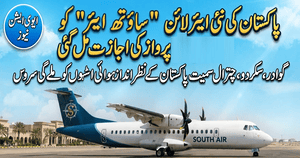
South Air Gets PCAA Commercial Flight Approval on Domestic Operations from Gwadar-Skardu plans.
Key Facts at a Glance
- South Air has received its Air Operator Permit for Wet Lease (AOP-WL) from PCAA — signed June 29, 2026
- Permit signed by PCAA Director General Nadir Shafi Dar — authorises commercial passenger services nationally
- Ministry of Defence and PCAA worked jointly to facilitate the certification
- Fleet: two ATR 72 aircraft under wet lease — one Italian crew, one on northern routes
- Airline formally inaugurated November 24, 2025 in Multan by then Senate Chairman Syed Yusuf Raza Gilani
- Trial flights already completed to New Gwadar International Airport and Sukkur Airport on May 25, 2026
- Planned network: Karachi, Gwadar, Panjgur, Turbat, Quetta, Zhob, Sukkur, Multan, Faisalabad, Sialkot, Islamabad, Skardu, Chitral
- Senate controversy: aviation officials claimed South Air was shifting from southern mandate to northern routes — Senate committee backed the airline
- Backed by SOS Group — CEO is Nishat Fatima, Deputy CEO Mohsin Jamil
- Licensed under Pakistan’s TPRI framework — Tourism Promotion and Regional Integration category
South Air Gets PCAA Commercial Flight Approval — Pakistan’s Newest Airline Is Ready to Fly
Pakistan has a new commercial airline ready to fly.
The Pakistan Civil Aviation Authority (PCAA) has issued an Air Operator Permit for Wet Lease (AOP-WL) to South Air, clearing the new private airline to begin commercial flight operations in Pakistan.
The permit, issued on June 29, authorises South Air to operate commercial passenger services within the country using wet leased aircraft.
The airline is expected to launch flight operations in the coming days after receiving the approval signed by PCAA Director General Nadir Shafi Dar.
According to the Civil Aviation Authority, the Ministry of Defence and the PCAA worked together to facilitate the airline’s certification.
For Pakistan’s aviation marke, dominated by PIA, Airblue, SereneAir, AirSial, and Fly Jinnah, this is a meaningful new entrant with a distinctly different focus. South Air is not another Lahore-Karachi carrier.

It is positioning itself as a regional connectivity airline specifically targeting the underserved airports that bigger carriers avoid.
Who Is South Air — Background and Ownership
South Air is not an overnight creation. It has been building its regulatory and operational foundation for over a year.
South Air (Pvt.) Limited is a Pakistani private regional airline headquartered in Karachi, operating under the Tourism Promotion and Regional Integration (TPRI) licensing framework of the Pakistan Civil Aviation Authority (PCAA).
Pakistan’s Civil Aviation Authority introduced the TPRI licence category under the National Aviation Policy 2019 to encourage private-sector entry into regional air travel markets not served by existing scheduled carriers.
South Air was formally inaugurated on 24 November 2025 at a ceremony in Multan attended by Syed Yusuf Raza Gilani, then Senate Chairman and Acting President of Pakistan. At the ceremony, partnership agreements were signed with Pakistan International Airlines.
The airline is backed by SOS Group. Nishat Fatima serves as Chief Executive Officer and Ejaz Mahmood Malik, a retired Air Vice Marshal of the Pakistan Air Force, is on the leadership team.
South Air Deputy CEO Mohsin Jamil has been the public face of the airline’s regulatory engagements throughout 2026, appearing before the Senate Standing Committee on Defence to defend the airline’s route strategy and expansion plans.
The Fleet — What South Air Is Flying
South Air Deputy CEO Mohsin Jamil told lawmakers that the airline currently operates two ATR 72 aircraft under wet-lease arrangements and plans to add another aircraft as it expands its domestic footprint.
What is a wet lease? A wet lease is an aviation arrangement where an aircraft is leased together with its crew, maintenance, and insurance, as a complete package.
The lessee (South Air) pays for the aircraft, pilots, maintenance, and insurance as one bundled deal rather than hiring its own crew separately.
This is a standard entry strategy for new airlines globally, it allows operations to begin quickly without the time and cost of building a full internal flight crew from scratch.
The Italian crew complication: South Air management explained that security restrictions affecting its foreign wet leased crew prevented operations to some destinations in Balochistan.
Jamil replied saying that the Italian crew cannot be replaced due to the wet-lease agreement covering aircraft, crew, maintenance, and insurance as a package.
This became a point of contention before the Senate committee, with aviation officials questioning why an airline licensed to serve southern Pakistan’s underserved routes could not operate to parts of Balochistan due to foreign crew security clearance issues.
Aircraft confirmed in operation:
| Aircraft | Registration | Route Operated |
|---|---|---|
| ATR 72-600 | 8Q-RAY (Maldives-registered) | Karachi–Gwadar proving flights |
| ATR 72-500 | LY-JUA (Lithuania-registered) | Karachi–Sukkur proving flights |
Both aircraft were confirmed in operation during proving flights on May 25, 2026, with PCAA inspectors aboard.
The Route Network — Where South Air Plans to Fly
South Air plans to connect Pakistan with a reliable network spanning Karachi, Gwadar, Panjgur, Turbat, Quetta, Zhob, Sukkur, Multan, Faisalabad, Sialkot, Islamabad, and Skardu.
South Air plans to operate flights to airports across Pakistan. The airline has already conducted test flights to New Gwadar International Airport and Sukkur Airport, with PCAA inspectors evaluating the operations during the flights.
Full planned network at a glance:
| Region | Destinations |
|---|---|
| Southern Pakistan | Karachi, Gwadar, Panjgur, Turbat, Sukkur |
| Balochistan | Quetta, Zhob |
| Central Punjab | Multan, Faisalabad |
| Northern Pakistan | Islamabad, Sialkot, Skardu, Chitral, Gilgit |
South Air’s network covers Karachi, Gwadar, Panjgur, Turbat, Quetta, Zhob, Sukkur, Multan, Faisalabad, Sialkot, Islamabad, and Skardu, with Rahim Yar Khan also listed as a planned destination. Planned routes to northern Pakistan include two daily services to Gilgit, Chitral, and Skardu, operating initially from Islamabad and Lahore.
The Gwadar route is particularly significant. In a significant boost to Gwadar’s air connectivity, South Air launched its first trial flight service from Karachi to Gwadar.
The trial flight successfully landed at the New Gwadar International Airport, marking a key step towards improving air travel facilities in the coastal region.
The new air service is also expected to significantly reduce travel time between Gwadar, Karachi, Quetta and other cities, while boosting trade, tourism and development activities across the Makran division.
The Senate Controversy — What Happened and How It Was Resolved
This is the backstory that explains why PCAA issued an AOP-WL rather than a full RPT licence, and why it matters.
Pakistan’s Senate Standing Committee on Defence said it supported the expansion of new regional carrier South Air to northern destinations, dismissing objections from aviation authorities that the airline had been licensed only to serve underserved southern regions.
During the meeting, aviation authorities and South Air management clashed over claims that the airline has shifted from its mandate of improving connectivity in underserved southern Pakistan to more profitable routes.
The Defence Secretary was particularly pointed in his criticism. “As the name South in South Air suggests, they have made us believe that they would operate in southern Pakistan, where other airlines do not fly,” Ali told lawmakers.
“Based on that commitment, we expedited their approval procedures, but now they are backtracking.”
South Air’s response was practical and legally sound. Senator Farooq H. Naik said during the meeting: “American airline does not operate only in America and Pakistan Airline does not operate within the country so if the airline is named South Air, it does not restrict it to operate only in South.”
Committee Chairman Talha Mahmood and other members endorsed South Air’s proposal to launch services to northern destinations, including Chitral, rejecting the notion that the airline’s name should restrict its route network.
The Senate committee’s backing cleared the political obstacle. The PCAA’s June 29, 2026 AOP-WL issuance followed.
AOP-WL vs RPT — Understanding the Difference
This distinction matters for passengers and investors watching the airline’s progress.
| Licence Type | What It Allows | South Air Status |
|---|---|---|
| TPRI Licence | Tourism & regional connectivity flights | ✅ Already held |
| AOP-WL (Air Operator Permit — Wet Lease) | Commercial passenger services using leased aircraft + crew | ✅ Issued June 29, 2026 |
| AOC (Air Operator Certificate) | Full airline operations certification | ✅ Already held |
| RPT (Regular Public Transport) Licence | Full scheduled commercial passenger services | 🔄 Application submitted — pending |
South Air has reportedly submitted an application to the Civil Aviation Authority seeking an RPT licence, which would allow it to formally operate scheduled passenger flights.
The AOP-WL issued June 29 allows South Air to begin flying commercially immediately.
The RPT licence, a higher regulatory standard, would give it the same standing as PIA, Airblue, AirSial, and Fly Jinnah as a full scheduled carrier. That process is ongoing.
What Makes South Air Different? South Air Gets PCAA Commercial Flight Approval on Domestic Operations
Pakistan’s existing private airlines concentrate heavily on the high-traffic trunk routes: Karachi–Lahore, Karachi–Islamabad, Lahore–Islamabad. These are the routes with highest passenger volumes and revenue.
South Air’s stated mission is specifically different. Positioning itself as a next-generation domestic carrier, South Air aims to make air travel more accessible, efficient, and affordable, particularly for underserved regions.
The underserved destinations on South Air’s network, Gwadar, Panjgur, Turbat, Zhob, Chitral, Skardu, tell this story clearly.
These are airports that PIA serves infrequently or not at all, where surface connectivity is often poor, and where seasonal demand from tourism and government/military travel exists but no reliable private carrier has committed.
According to the private airline spokesperson, improved connectivity between the Gwadar seaport and international airport could help transform the city into a modern commercial and transit hub where maritime and air transport complement each other.
The development is expected to not only generate employment opportunities and promote business activity but also contribute to the region’s overall economic growth.
Pakistan’s Growing Private Aviation Ecosystem — South Air Gets PCAA Commercial Flight Approval on Domestic Operations
South Air enters a domestic aviation market that has genuinely transformed over the past five years.
Pakistan’s scheduled domestic airline landscape as of July 2026:
| Airline | Founded | Base | Focus |
|---|---|---|---|
| PIA | 1955 | Karachi | National carrier, domestic + international |
| Airblue | 2003 | Karachi | Domestic, low-cost focus |
| SereneAir | 2017 | Islamabad | Full-service, domestic + regional |
| AirSial | 2020 | Sialkot | Domestic + expanding international (Dubai, Jeddah) |
| Fly Jinnah | 2021 | Karachi | Low-cost, domestic + Dhaka approved |
| South Air | 2025 | Karachi | Regional, underserved airports, TPRI framework |
The addition of South Air, specifically focused on regional and underserved connectivity, fills a genuine gap in this lineup. No existing private carrier has committed to Gwadar, Panjgur, Turbat, and Zhob as core network destinations.
The Gwadar Opportunity –
Of all South Air’s planned destinations, Gwadar carries the most strategic weight.
The operationalisation of the Gwadar airport under the China-Pakistan Economic Corridor (CPEC) project is expected to facilitate smoother movement of passengers, cargo and services.
New Gwadar International Airport, one of Pakistan’s most modern airport facilities, has been operational for years but has seen limited commercial traffic.
A dedicated regional carrier committing to regular Karachi–Gwadar service directly supports CPEC’s commercial viability, gives Gwadar-based businesses an air link, and opens the Makran coast to domestic tourism.
The route also has practical government and defence significance, a point not lost on the Senate committee that backed South Air’s expansion.
Frequently Asked Questions – South Air Gets PCAA Commercial Flight Approval on Domestic Operations
Q1: What is South Air and when did it get approval?
Ans. South Air is a new Pakistani private regional airline headquartered in Karachi. The PCAA issued it an Air Operator Permit for Wet Lease (AOP-WL) on June 29, 2026, signed by DG PCAA Nadir Shafi Dar, authorising it to begin commercial passenger services.
Q2: What type of aircraft does South Air operate?
Ans. South Air currently operates two ATR 72 aircraft, a 72-600 and a 72-500 , under wet-lease arrangements, with Italian crew. A third aircraft is planned as the network expands.
Q3: What is a wet lease?
Ans. A wet lease means the aircraft comes with its crew, maintenance, and insurance as a complete package. The lessee operates the aircraft commercially but does not employ the crew directly.
Q4: Which airports will South Air fly to?
Ans. South Air’s planned network covers Karachi, Gwadar, Panjgur, Turbat, Quetta, Zhob, Sukkur, Multan, Faisalabad, Sialkot, Islamabad, Skardu, Chitral, and Gilgit.
Q5: Has South Air already conducted any flights?
Ans. Yes. South Air completed test flights to New Gwadar International Airport and Sukkur Airport on May 25, 2026, with PCAA inspectors evaluating operations aboard both flights.
Q6: What was the Senate controversy about?
Ans. Aviation authorities claimed South Air secured fast-track approval by promising to serve underserved southern Pakistan but was then pivoting to more profitable northern routes. The Senate Standing Committee on Defence backed the airline’s right to expand nationally, and the AOP-WL followed.
Q7: Does South Air have a full RPT licence?
Ans. Not yet. South Air currently holds a TPRI licence, an AOC, and the newly issued AOP-WL. It has applied for an RPT licence, the standard for full scheduled commercial operations, which is still pending.
Q8: Who owns South Air?
Ans. South Air is backed by SOS Group. CEO is Nishat Fatima and Deputy CEO is Mohsin Jamil. The operational leadership includes retired Pakistan Air Force officials.
Q9: When will South Air begin commercial flights?
Ans. The airline is expected to launch commercial flights in the coming days following the June 29 permit issuance.
The Bottom Line – South Air Gets PCAA Commercial Flight Approval on Domestic Operations
South Air’s AOP-WL issuance on June 29, 2026 is the regulatory green light that turns a well-backed regional airline concept into a commercial reality.
What makes this more than a routine aviation news story is the route network. Pakistan’s existing private airlines have largely ignored Gwadar, Panjgur, Turbat, Zhob, and the underserved northern mountain airports in favour of the profitable trunk routes.
South Air’s stated commitment to these destinations, backed by proving flights already completed and Senate support secured, represents a genuine addition to Pakistan’s aviation connectivity that serves regions most neglected by the existing market.
The coming days will reveal the inaugural commercial schedule. When it lands, South Air becomes Pakistan’s sixth active domestic private carrier, and arguably the one with the most strategically important route map.
South Air Gets PCAA Commercial Flight Approval on Domestic Operations from Gwadar-Skardu plans.
Disclaimer/Note: The information above might not be 100% correct. Please verify from your own sources. We will not be responsible for any kind of loss or liability due to our content.
For more news, please visit Munafa Marketing.