
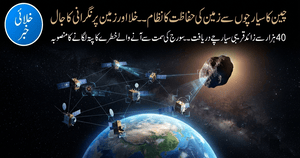
China is Building Planetary Defence System to Protect Earth From Asteroids with no blind spots.
The Story in 60 Seconds:
- China’s CNSA is developing a space-ground integrated asteroid monitoring and early-warning network — announced July 1, 2026 on International Asteroid Day
- Source: Li Mingtao, Chief Scientist at CNSA’s Asteroid Monitoring and Early Warning Research Center
- System design: ground telescopes + a space-based monitoring constellation = 24/7, no-blind-spot surveillance
- Over 40,000 near-Earth asteroids have been discovered and catalogued globally as of June 2026
- No asteroid has been confirmed on a collision course with Earth — but thousands remain undetected
- The biggest threat: asteroids approaching from the sun’s direction — invisible to ground telescopes
- If a threat is confirmed: automatic orbit calculation + immediate notification to authorities and the public
- Two deflection methods confirmed: kinetic impact (most viable now) and slow-force techniques needing 10+ years of notice
- China’s first asteroid deflection test mission targets 2015 XF261 — expected to launch before 2030
- Tianwen-2 already en route to asteroid 2016HO3/Kamoʻoalewa — arriving summer 2026 for sample collection
China Is Building a Planetary Defence System to Protect Earth From Asteroids — Complete Breakdown
This is not a random announcement. The timing is deliberate and globally significant.
China is working on a space-ground integrated monitoring and early-warning network as a core component of a planetary defence system that is under a feasibility study, according to a scientist familiar with the plan.
The announcement was made by Li Mingtao, Chief Scientist at the asteroid monitoring and early-warning research centre under the China National Space Administration (CNSA), on July 1, 2026, which is International Asteroid Day, designated by the United Nations to raise global awareness about asteroid impact hazards and promote planetary defence education.
The choice of International Asteroid Day for this disclosure is a clear signal: China is not just building infrastructure internally.
It is positioning itself as a global planetary defence actor, one that takes the threat seriously enough to announce developments on the very day the UN set aside for this purpose.
The Threat — What Are Near-Earth Asteroids and Why Do They Matter?
Before understanding China’s defence system, you need to understand what it is defending against.
What is an asteroid?
An asteroid is a rocky, airless remnant left over from the formation of the solar system approximately 4.6 billion years ago. Most reside in the asteroid belt between Mars and Jupiter.
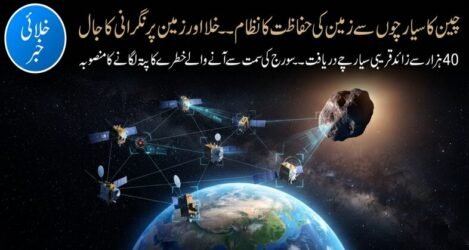
Near-Earth Asteroids (NEAs) are those whose orbits bring them within a certain distance of Earth’s path around the sun.
What is a near-Earth asteroid?
A near-Earth asteroid is any asteroid that orbits within 1.3 astronomical units (AU) of the sun, meaning its path can bring it close to Earth’s neighbourhood. Of these, those with orbits that could bring them within 0.05 AU of Earth and are larger than 140 metres in diameter are classified as Potentially Hazardous Asteroids (PHAs).
How many are there?
More than 40,000 near-Earth asteroids have been discovered and catalogued worldwide as of June 2026. No asteroid has so far been identified that will definitely collide with Earth in the foreseeable future, but concerns over impact risks are not unfounded.
Many near-Earth asteroids remain undetected.
What happens if one hits Earth? The consequences depend entirely on size. Here is the confirmed science:
| Asteroid Size | Impact Effect | Historical Example |
|---|---|---|
| Under 25 metres | Burns up in atmosphere — meteor shower | Chelyabinsk, Russia 2013 (20m, injured 1,500) |
| 25–140 metres | Regional devastation — flattens cities | Tunguska, Siberia 1908 (50m, flattened 2,000 km²) |
| 140m–1 kilometre | Continental-scale destruction | No recent example |
| Over 1 kilometre | Global catastrophe | Chicxulub impact 66 million years ago — wiped out dinosaurs |
Larger asteroids pose greater potential devastation but are easier to detect early due to their brightness. Smaller asteroids are harder to spot but cause less damage. This disparity underscores the critical importance of building a comprehensive monitoring system.
China’s System Design: How It Works?
The system China is building solves a fundamental problem with asteroid detection: you cannot watch the whole sky from one place.
Ground Component — The Telescope Network
On the ground, China will deploy multiple large-aperture optical telescopes at carefully chosen sites, forming a geographically balanced network for long-range, wide-coverage and precise night-sky surveys.
The Longma Astronomical Observatory in Jinzhai County, Anhui Province, pictured in CGTN’s July 1 report, is part of this ground infrastructure. Ground telescopes provide high-resolution optical imaging, precise orbit calculation, and long-duration tracking of known objects.
The critical weakness of ground telescopes:
Ground telescopes are blinded by the sun’s glare due to atmospheric scattering. They simply cannot see asteroids approaching from the direction of the sun.
This is precisely the direction where the most dangerous undetected threats could be hiding, objects on a direct collision path with Earth come from the sunward direction.
Space Component — The Monitoring Constellation
China also intends to launch a space-based monitoring constellation, a network of telescopes operating above Earth’s atmosphere, free from atmospheric and day-night constraints, specifically targeting threats from the sunward direction.
This mirrors a concept China’s own scientists have been developing for years, the CROWN (Constellation of Heterogeneous Wide-field NEO Surveyors) proposal, which would deploy six to eight microsatellites in heliocentric orbits inside the orbit of Venus, covering the blind zone that defeats ground telescopes.
The Combined System — 24/7, No Blind Spots
Through coordinated ground-space operations, the system will achieve seamless day-and-night monitoring. The two components complement each other precisely:
| Component | Strength | Limitation Overcome |
|---|---|---|
| Ground telescopes | High resolution, precise tracking, large aperture | Cannot see sunward direction |
| Space constellation | Monitors sunward threats, unaffected by atmosphere or daylight | Limited resolution vs ground |
| Combined system | Round-the-clock, 360-degree coverage with no blind spots | Eliminates all coverage gaps |
The Early Warning System — What Happens When a Threat Is Detected
China has already made initial breakthroughs in risk assessment models and algorithms and is developing an operational near-Earth asteroid early-warning system.
Here is the confirmed detection-to-response chain:
- Step 1 — Detection A telescope in the ground-space network detects a suspicious moving object against the background of fixed stars.
- Step 2 — Automatic orbit calculation Once a telescope detects a suspicious target, the system will automatically calculate its orbit and assess impact probability without human intervention in the initial stage. Speed is critical, the faster the orbit is calculated, the more time there is to respond.
- Step 3 — Threat assessment The automated system evaluates the probability of Earth impact based on the calculated orbit. Early warning time varies dramatically depending on the asteroid’s size and when it is discovered.
- Step 4 — Notification If a credible and urgent threat is confirmed, authorities will be notified immediately, and the public will receive clear information about the risk and recommended actions.
The key variable — time: The biggest determinant of what can be done about an asteroid is how much warning time exists. Years of warning allows gentle deflection. Months of warning means kinetic impact only. Days of warning means evacuation of affected areas. No warning is a catastrophe.
What China Can Actually Do About an Asteroid — The Deflection Methods
Detection is only half the problem. Here is what happens if a genuine threat is confirmed.
Method 1 — Kinetic Impact (Most Viable Now)
Kinetic impact means a spacecraft is launched on a collision course with the asteroid, hitting it at high speed to shift its orbit slightly. A small orbital change, applied early enough, means the asteroid misses Earth by a safe margin.
Should an asteroid threaten Earth, kinetic impact, a high-speed strike that instantly shifts the asteroid’s orbit, is the first choice. It is simple, reliable and the most viable option, said Li.
Proof it works: NASA’s DART (Double Asteroid Redirection Test) mission successfully impacted the asteroid Dimorphos in September 2022, altering its orbit by 33 minutes. This was humanity’s first demonstration that kinetic deflection is real, measurable, and effective.
Method 2 — Slow Force Techniques (Long Lead Time Required)
The second category includes gravity tractors, ion beams and laser ablation, but these exert very weak forces and require over a decade of advance notice to be effective.
| Technique | How It Works | Lead Time Required | Status |
|---|---|---|---|
| Kinetic Impact | Spacecraft physically crashes into asteroid | Years — months | ✅ Proven by NASA DART 2022 |
| Gravity Tractor | Spacecraft hovers near asteroid, tugs it gravitationally | 10+ years | Theoretical |
| Ion Beam | Ions fired at asteroid create reactive thrust | 10+ years | Theoretical |
| Laser Ablation | Laser vaporises surface material, creating reactive push | 10+ years | Theoretical |
| Nuclear deflection | Detonation near or on asteroid | Last resort — years | Not tested |
China’s Active Space Missions: China is Building Planetary Defence System to Protect Earth
China is not just planning on paper. Two concrete missions anchor its asteroid programme.
Tianwen-2 — Already En Route (Sample Return Mission)
China is flying its first asteroid sample return mission, Tianwen-2, which is en route to asteroid 2016HO3/469219 Kamoʻoalewa, with a planned arrival in the summer of 2026.
The mission will gather between 200 and 1,000 grams of samples. Around 2029, those samples will be returned to Earth for study during a flyby.
Kamoʻoalewa is a small near-Earth asteroid approximately 40-100 metres across that has a peculiar orbital pattern near Earth. Studying its composition directly contributes to the science of understanding what asteroids are made of critical for designing effective deflection methods.
Planetary Defence Test Mission — Target: Asteroid 2015 XF261
China’s CNSA mission may have already selected its target for a kinetic deflection test, the near-Earth object 2015 XF261, a nearly 30-metre wide asteroid.
The mission plan combines the objectives of NASA’s DART and ESA’s Hera missions into a single launch:
- An observer spacecraft will first spend 3-6 months studying the asteroid’s size, shape, composition, and orbit up close
- A separate impactor spacecraft will then perform a high-speed kinetic impact
- The observer will monitor the impact and aftermath for 6-12 months
Best launch opportunities occur in April 2029 and April 2030 when 2015 XF261 makes its closest approaches to Earth.
China vs the Rest of the World: China is Building Planetary Defence System to Protect Earth
China is not the only country taking asteroid defence seriously. Here is how the global effort stacks up.
| Organisation | Mission/System | Status |
|---|---|---|
| NASA (USA) | DART — kinetic impact test | ✅ Completed 2022 — Success |
| ESA (Europe) | Hera — DART follow-up study | ✅ En route to Dimorphos 2026 |
| NASA | NEO Surveyor space telescope | 🔄 Under development |
| China (CNSA) | Tianwen-2 — asteroid sample return | ✅ En route — arrives 2026 |
| China (CNSA) | Space-ground monitoring network | 🔄 Feasibility study — announced July 2026 |
| China (CNSA) | Kinetic deflection test — 2015 XF261 | 🔜 Target pre-2030 |
| UN/International | Planetary Defence Coordination | 🔄 Ongoing — International Asteroid Da |
The greatest risk comes from undiscovered near-Earth asteroids, which are numerous, faint, and potentially approaching from the sun. That is why global scientists are racing to build monitoring and early-warning capabilities and catalog them.
The Two Key Messages From Li Mingtao
China’s chief asteroid scientist delivered two deliberately calibrated statements that deserve close attention.
Statement 1 — No confirmed threat, but no room for complacency: “No asteroid has so far been identified that will definitely collide with Earth in the foreseeable future, but concerns over impact risks are not unfounded. Many near-Earth asteroids remain undetected.”
Statement 2 — Calm, not panic: “We must never let our guard down, but there is also no need for excessive anxiety.”
These two statements together define the correct public posture: the threat is real and taken seriously by global science, but it is a manageable, low-probability risk, not an imminent catastrophe.
The purpose of monitoring systems is precisely to ensure that “low-probability” never means “undetected until it is too late.”
What Is International Asteroid Day?
For readers unfamiliar with the event: International Asteroid Day is a UN-designated global awareness event held annually on June 30, coinciding with the anniversary of the Tunguska impact event of June 30, 1908, when a 50-metre asteroid or comet fragment exploded over Siberia with the force of roughly 1,000 Hiroshima bombs, flattening approximately 2,000 square kilometres of forest.
No one was killed because the region was uninhabited, but the same event over any major city would have been catastrophic.
The day was established to raise public awareness of asteroid impact hazards and promote education about planetary defence. China’s announcement on this specific date is a conscious alignment with the global science and policy community’s emphasis on the issue.
Frequently Asked Questions – China is Building Planetary Defence System to Protect Earth
Q1: What did China announce about asteroid defence on July 1, 2026?
Ans. China’s CNSA Chief Scientist Li Mingtao announced that China is developing a space-ground integrated monitoring and early-warning network as the core of its planetary defence system, combining ground-based optical telescopes with a space-based monitoring constellation to achieve round-the-clock, no-blind-spot asteroid surveillance.
Q2: How many near-Earth asteroids have been discovered?
Ans. More than 40,000 near-Earth asteroids have been discovered and catalogued worldwide as of June 2026. No asteroid has been confirmed on a definitive collision course with Earth.
Q3: Why do ground telescopes have a blind spot?
Ans. Ground telescopes are blinded by the sun’s glare due to atmospheric scattering, they cannot detect asteroids approaching from the direction of the sun. This is precisely where undetected threats could be hiding, which is why a space-based constellation is needed to complement them.
Q4: What is the most effective method for deflecting an asteroid?
Ans. Kinetic impact, physically crashing a spacecraft into the asteroid to alter its orbit, is the most viable and proven method. It was successfully demonstrated by NASA’s DART mission in 2022.
Q5: What is China’s Tianwen-2 mission?
Ans. Tianwen-2 is China’s first asteroid sample return mission, currently en route to asteroid 2016HO3/Kamoʻoalewa, expected to arrive in summer 2026 to collect 200-1,000 grams of asteroid samples for return to Earth around 2029.
Q6: What is China’s planned asteroid deflection test target?
Ans. China’s CNSA has indicated the near-Earth asteroid 2015 XF261, a roughly 30-metre wide object, as a likely target for its first kinetic deflection test mission, expected to launch before 2030.
Q7: What is International Asteroid Day?
Ans. A UN-designated global awareness event held annually on June 30, marking the anniversary of the 1908 Tunguska impact event, to raise public awareness of asteroid hazards and promote planetary defence education.
The Bottom Line – China is Building Planetary Defence System to Protect Earth
China’s planetary defence announcement lands at a moment when the global scientific community is accelerating its response to a threat that is genuinely low-probability, but whose consequences, if undetected, would be civilisation-level.
The architecture China is building, ground telescopes combined with a space constellation targeting the sunward blind spot, is technically sound and directly addresses the most significant gap in current global detection capabilities.
NASA proved kinetic deflection works in 2022 with DART. ESA is now studying the impact with Hera. China is racing to join both the detection and deflection races before 2030, with Tianwen-2 already en route, a deflection test mission in planning, and now a comprehensive monitoring network entering feasibility study.
The asteroid threat is not science fiction. The Tunguska event happened 118 years ago. The Chelyabinsk meteor injured 1,500 people in 2013. The difference between those incidents and a civilisation-ending impact is asteroid size, and the only answer to size is early detection.
That is precisely what China is now building.
Disclaimer/Note: The information above might not be 100% correct. Please verify from your own sources. We will not be responsible for any kind of loss or liability due to our content.
For more news, please visit Munafa Marketing.