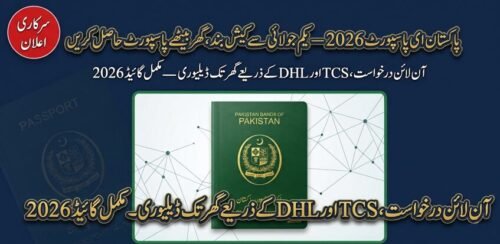
Pakistan will Shift to E-Passports from 1st July 2026 and only QR code-based digital payments will be allowed.
What Is Changing and When:
- Cashless passport fees start July 1, 2026, QR code payments only, no cash at any office
- Full shift to e-passports approved, machine-readable passports (MRPs) being phased out gradually
- No deadline set yet for when MRPs will be completely discontinued; existing passports remain valid
- Online applications shifting to the PakID platform, apply from home without visiting offices
- Delivery partners confirmed: TCS (domestic) and DHL (overseas Pakistanis)
- Business passport policy being finalised with FBR, a separate fast-track category coming
- Decision announced: June 19–20, 2026, meeting chaired by Interior Minister Mohsin Naqvi
- DG Immigration: Muhammad Ali Randhawa briefed the minister and presented the full reform roadmap
Pakistan E-Passport 2026: Cashless Payments From July 1, Home Delivery & Full Digital Overhaul – Complete Guide
Pakistan’s passport system is getting its most significant overhaul in decades.
- The Government of Pakistan has announced a complete transition from machine-readable passports to advanced e-passports with embedded biometric chips, phasing out traditional passports.
- Interior Minister Mohsin Naqvi confirmed the move to enhance security, reduce fraud, and comply with ICAO standards.
- Chairing a special meeting at the Passport and Immigration Headquarters, Naqvi said the complete transition would eliminate fraud and forgery. “The complete transition to e-passports will end fraud and forgery related to passports,” he said.
- Director General of Passports and Immigration Muhammad Ali Randhawa briefed the minister on the reforms. The meeting approved in principle to shift to e-passports, though no cutoff date for phasing out old passports was set.
Four major changes were announced simultaneously. Here is each one in full detail.
Change 1 — Cashless Payments From July 1, 2026
This is the change with the most immediate deadline, and it affects every Pakistani applying for a passport right now.
Read More: Now You Can Apply for Passport from Anywhere
All passport offices across Pakistan will move to a cashless payment system from July 1, ending manual cash handling at banks.
Only QR code-based digital payments will be allowed. All passport offices across Pakistan will adopt the system. The aim is to reduce corruption risks and speed up processing.
Read More: Hajj 2027 Registration in Pakistan Opens on June 22
What this means practically: Pakistan will Shift to E-Passports from 1st July 2026
From July 1, 2026, if you walk into any passport office with cash, you will not be able to pay. You must have a payment method capable of scanning a QR code, this includes any banking app (HBL, MCB, UBL, Meezan, JazzCash, EasyPaisa, and others) with QR payment functionality.
⚠️ Action required before July 1: If you or a family member plans to apply for a passport in the coming weeks, make sure your mobile banking app is set up and your QR payment function is active. Do not arrive at a passport office with cash only after July 1.
Accepted payment methods going forward:
- Mobile banking apps with QR scan (HBL, MCB, UBL, Allied, Meezan, etc.)
- JazzCash QR payment
- EasyPaisa QR payment
- Any bank debit/credit card linked to a QR-capable app
Change 2 — Full Shift to E-Passports — What This Means
An e-passport is a highly secure travel document embedded with a contactless electronic chip that stores biometric and personal information, including facial details, biographical data, a unique identification number, and a digital signature. The chip can be read wirelessly by border control systems and compatible devices.
E-passport vs Machine Readable Passport — Side by Side:
| Feature | Machine Readable Passport (MRP) | E-Passport (Biometric) |
|---|---|---|
| Security chip | ❌ None | ✅ NFC contactless chip |
| Biometric data stored | ❌ No | ✅ Face, fingerprints, iris |
| Digital signature | ❌ No | ✅ Yes |
| Forgery difficulty | Moderate | Extremely high |
| E-gate access at airports | ❌ No | ✅ Yes — worldwide |
| Immigration queue time | Longer | Significantly reduced |
| ICAO compliance | Partial | ✅ Full compliance |
| Fraud risk | Higher | Substantially lower |
Pakistan’s e-passports comply with standards set by the International Civil Aviation Organization (ICAO), allowing holders to use automated e-gates at airports around the world and reducing waiting times at immigration counters.
What about your current MRP passport?
The shift does not mean that existing passports are being cancelled immediately. No deadline has been announced for phasing out current passport types. Instead, the reform is expected to move in stages so the department can upgrade systems, payment channels, and service delivery without disrupting applicants.
✅ Clear answer: Your current MRP passport remains valid until its expiry date. You do not need to rush to replace it. When it nears expiry — apply for the new e-passport.
Complete E-Passport Fee Structure 2026 — Confirmed
The official confirmed fee structure for both passport types is as follows:
Standard Machine Readable Passport (MRP) Fees
| Validity | Pages | Fee |
|---|---|---|
| 5 years | 36 pages | Rs. 4,500 |
| 10 years | 36 pages | Rs. 6,700 |
| 5 years | 72 pages | Rs. 7,500 |
| 10 years | 72 pages | Rs. 11,200 |
Biometric E-Passport Fees
| Validity | Pages | Normal Fee | Urgent Fee |
|---|---|---|---|
| 5 years | 36 pages | Rs. 9,000 | Rs. 15,000 |
| 10 years | 36 pages | Rs. 13,500 | Rs. 22,500 |
| 5 years | 72 pages | Rs. 13,500 | Rs. 22,500 |
| 10 years | 72 pages | Rs. 18,000 | Rs. 40,500 |
💡 Which should you choose? For most regular travellers — the 10-year, 36-page e-passport at Rs. 13,500 offers the best value. Heavy travellers with multiple visa stamps should opt for the 72-page version.
Officials also confirmed that citizens using premium services will pay fees according to the actual cost of the relevant passport facility, meaning premium fast-track fees will be recalibrated to reflect true service costs.
Change 3 — Home Delivery via TCS and DHL
One of the most welcomed announcements for Pakistani passport applicants is the end of the dreaded second visit to collect a completed passport.
Randhawa informed the meeting that initial work on the home delivery of passports for citizens in Pakistan and abroad had been completed. “The process of providing passports at citizens’ doorsteps will start soon,” Naqvi said.
Delivery partners confirmed: TCS (domestic) and DHL (overseas Pakistanis)
What this means: Pakistan will Shift to E-Passports from 1st July 2026
- Apply for your passport, in person for first-time biometrics, or online for renewals
- Pay via QR code
- Receive your completed passport at your home address
- No second trip to the passport office required
- Overseas Pakistanis can receive passports at their international address via DHL
⚠️ Status check: Home delivery preparations are complete but a formal launch date has not yet been officially confirmed. The system is described as launching “soon.” Keep checking passport.gov.pk for the live announcement.
Change 4 — Online Applications via PakID Platform
Online passport applications will be shifted to the Pak-ID platform, streamlining submissions and significantly cutting processing times.
What the PakID passport application will allow:
Citizens can submit their photos, signatures, and up-to-date iris dataset directly via the PakID mobile application without visiting offices during normal renewals where there are no changes in core information. For first-time applicants or those changing biometric data, an in-person visit remains required.
First-time applicants — in-person biometric visit still required:
First-time e-passport applicants must complete an in-person biometric capture at their closest Regional Passport Office (RPO) or Executive Passport Office.
A live operator will capture a high-resolution digital photo, iris scan, and 10-fingerprint biometrics. Your official details will be read back to you before being sent to the Central Printing Department in Islamabad.
Business Passport Policy — What Is Coming
The meeting also decided to finalise a policy for business passports in consultation with the Federal Board of Revenue.
The Business Passport Policy is to be finalised soon in consultation with the FBR, a separate category designed to facilitate business travellers in obtaining passports more efficiently.
Details of the business passport category, eligibility criteria, fees, processing timelines, and benefits, have not yet been officially confirmed. This is being treated as a separate policy track from the main e-passport rollout.
⚠️ Authenticity note: Any specific details about Business Passport fees or requirements circulating on social media are not yet officially confirmed. Wait for the official FBR-MoI announcement before acting.
What Documents Do You Need for an E-Passport Application?
For all applicants:
- Original valid CNIC (or NICOP for overseas Pakistanis)
- Previous passport (if renewing)
- PSID receipt (generated after online fee payment)
- Mobile banking app for QR payment (from July 1 onwards)
For minors:
- Original B-Form (birth registration certificate)
- Parent/guardian’s original CNIC
- Parent/guardian’s passport copy
For overseas Pakistanis:
- NICOP (National Identity Card for Overseas Pakistanis)
- Pakistani passport (if renewing)
- Proof of overseas address for DHL home delivery
How to Apply — Step by Step (2026 Process)
- Step 1 — Visit passport.gov.pk or the PakID app
Go to the official Directorate General of Immigration and Passports portal at passport.gov.pk or download the PakID app.
- Step 2 — Fill in your application form
Complete the online application with your personal details, passport type, validity, and page count selection.
- Step 3 — Pay the fee via QR code
Generate your PSID receipt and pay using your mobile banking app’s QR scan function. Keep the payment confirmation.
- Step 4 — Book your biometric appointment (first-time applicants)
Select your nearest Regional Passport Office or Executive Passport Office and book a biometric appointment slot. Renewal applicants with no biometric changes may complete the process entirely via the PakID app.
- Step 5 — Attend biometric capture (if required)
Arrive at the passport office with your original documents and PSID receipt. Complete fingerprint, iris, and photo capture.
- Step 6 — Receive passport at home
Once printed and dispatched — your passport will be delivered to your registered address via TCS (domestic) or DHL (overseas).
Passport Offices Across Pakistan — Key Locations
| City | Office Type | Address |
|---|---|---|
| Islamabad | Passport HQ & RPO | Sector G-8/4, Islamabad |
| Lahore | Regional Passport Office | 5-Bank Square, The Mall |
| Karachi | Regional Passport Office | Club Road, Civil Lines |
| Peshawar | Regional Passport Office | Circular Road, Peshawar |
| Quetta | Regional Passport Office | Zarghoon Road, Quetta |
| Multan | Executive Passport Office | Near Qasim Bagh Stadium |
| Rawalpindi | Executive Passport Office | Commercial Market, Saddar |
📞 Passport Helpline: 051-9204915 | 051-9205402
🌐 Official portal: passport.gov.pk
📧 Email: dgpassport@interior.gov.pk
Why This Reform Matters: Pakistan will Shift to E-Passports from 1st July 2026
Pakistan’s passport system has historically suffered from three interconnected problems: corruption at payment counters, document fraud enabled by MRP security gaps, and an inefficient two-visit collection process that cost applicants time and money.
The four reforms announced address all three simultaneously.
- Cashless payments eliminate corruption at the counter. When no cash changes hands, there is no mechanism for unofficial payments or queue-jumping facilitated by cash incentives. Every transaction is digitally logged.
- E-passports eliminate document fraud. The shift is expected to align Pakistan’s travel documents with global standards used by many developed countries. The new system will help reduce fraud and forgery, which have been long-standing issues in passport issuance.
- Home delivery and online applications eliminate the double-visit bottleneck. The two-visit system, apply in person, then return to collect, has been one of the primary causes of overcrowding at passport offices and informal payments to agents who promise “faster” collection.
The reform is expected to move in stages so the department can upgrade systems, payment channels, and service delivery without disrupting applicants who need travel documents for work, study, family visits, or business travel.
Frequently Asked Questions (FAQs) for Pakistan will Shift to E-Passports from 1st July 2026
Q1: When do cashless passport payments start?
Ans. All passport offices across Pakistan will move to a cashless payment system from July 1, 2026, ending manual cash handling at banks.
Q2: Is my current MRP passport still valid?
Ans. Yes. Existing valid machine-readable passports will remain usable until their expiry dates. No deadline has been announced for phasing out current passport types.
Q3: What is an e-passport and how is it different?
Ans. An e-passport contains a contactless NFC chip storing biometric data including facial details, biographical information, a unique ID number, and a digital signature, readable wirelessly by border control systems. Unlike MRPs, e-passports allow use of automated e-gates at international airports worldwide.
Q4: Who announced this reform?
Ans. Interior Minister Mohsin Naqvi announced the reform after chairing a special meeting at the Passport and Immigration Headquarters. DG Immigration Muhammad Ali Randhawa briefed the minister on the full reform roadmap.
Q5: When will home delivery start?
Ans. Preparatory work for home delivery of passports for citizens in Pakistan and abroad has been completed. “The process of providing passports at citizens’ doorsteps will start soon,” Naqvi confirmed, but no specific launch date has been announced.
Q6: Who are the home delivery partners?
Ans. TCS for domestic delivery and DHL for overseas Pakistani applicants are the confirmed delivery partners.
Q7: Can overseas Pakistanis apply online?
Ans. Yes. Applications will be shifted to the Pak ID platform for online processing, including for overseas Pakistani applicants.
Q8: What is the e-passport fee for a 10-year passport?
Ans. A 10-year, 36-page biometric e-passport costs Rs. 13,500 (normal) or Rs. 22,500 (urgent). A 10-year, 72-page e-passport costs Rs. 18,000 (normal) or Rs. 40,500 (urgent).
Q9: What is the Business Passport Policy?
Ans. A business passport policy is being finalised in consultation with the FBR. Specific details have not yet been officially announced.
The Bottom Line – Pakistan will Shift to E-Passports from 1st July 2026
Pakistan’s passport system is undergoing the most significant structural reform in its history, and most of it is happening right now, not in some distant future.
The July 1 cashless deadline is the most immediate priority. Every Pakistani planning a passport application in the coming months must have their mobile banking app set up and QR payment enabled before walking into any passport office.
The e-passport transition is long-term and gradual. Your current MRP passport is safe. No rush to replace it, but when renewal time comes, the e-passport delivers meaningfully better security, global e-gate access, and significantly reduced fraud risk.
Home delivery and online applications will remove the two biggest pain points of the current system, the crowded offices and the double-visit requirement, once fully operational.
Pakistan is moving in the right direction. The execution timeline is the only question that remains.
Pakistan will Shift to E-Passports from 1st July 2026 and only QR code-based digital payments will be allowed.
Disclaimer/Note: The information above might not be 100% correct. Please verify from your own sources. We will not be responsible for any kind of loss or liability due to our content.
For more news, please visit Munafa Marketing.