
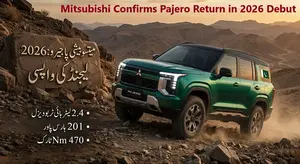
Mitsubishi Confirms Pajero Return in 2026 Debut, powered by a 2.4-liter bi-turbo diesel engine, 201 horsepower, and 470 Nm of torque, providing strong performance, excellent towing capability, and efficient fuel economy.
Mitsubishi Pajero 2026 Is Official: Everything You Need to Know About the Legendary SUV’s Return
The iconic off-roader is coming back after a five-year absence, built tougher, positioned higher, and ready to take on the Toyota Land Cruiser.
The Comeback Nobody Expected But Everyone Wanted
After five years of silence, Mitsubishi has made it official. The Pajero is coming back.
The Japanese automaker confirmed on May 29, 2026, that its all-new cross-country SUV will carry the legendary Pajero nameplate, with a global world premiere set for autumn 2026.
Read More: Rise of Hybrid SUVs in Automotive Industry Pakistan
In select markets, including North America, South America, Spain, and the Philippines, the same vehicle will be sold as the Mitsubishi Montero, reviving that equally storied badge in the same announcement.
This is not a rumor, a rendering, or a hopeful leak. It is an official factory confirmation, and it ends years of speculation that began when spy shots of a boxy, muscular test mule first surfaced in mid-2025.
For anyone who grew up watching Pajeros conquer the Dakar Rally or who remembers the SUV parked in a driveway as the symbol of serious capability, this is a big deal.
But the question on every buyer’s mind is the same: is this a genuine return to form, or just a famous badge draped over something ordinary? Based on what Mitsubishi has disclosed so far, the answer looks genuinely promising.

Why the Pajero Name Still Carries So Much Weight
To understand why this announcement matters, you have to understand what the Pajero actually was, not just as a product, but as a cultural and motorsport phenomenon.
First breaking cover in 1982, the Pajero fundamentally reshaped the automotive landscape by bridging the gap between a utilitarian four-wheel-drive machine and the everyday comfort of a passenger car.
Before it existed, you either drove a spartan 4×4 that punished you on the highway, or a comfortable car that would get stuck in mud. The Pajero was the first generation of what we now take for granted as the modern SUV.
Across four generations, it evolved into an absolute powerhouse for the brand, racking up cumulative global sales exceeding 3.25 million units across 170 countries.
That is not just commercial success, that is a vehicle that genuinely resonated with buyers on every inhabited continent.
Then came the motorsport chapter. The nameplate cemented its legendary status in the motorsport world through the grueling Dakar Rally, securing a historic 12 victories, including an unmatched streak of seven consecutive wins.
Those wins were not marketing stunts.
The Dakar Rally runs through some of the most punishing terrain on the planet, and the Pajero won it more than any other vehicle in history. That record is the bedrock of its reputation among serious off-road buyers.
The fourth-generation model was phased out for overseas markets in 2021 after being sold largely unchanged since 2006. It left the market feeling dated, but it left a gap that no other Mitsubishi product has come close to filling.
What Mitsubishi Has Officially Confirmed – Mitsubishi Confirms Pajero Return in 2026 Debut
Mitsubishi has been deliberate about what it is revealing ahead of the autumn premiere, but the confirmed details already paint a clear picture of the vehicle’s character and positioning.
The new Pajero will be built on a ladder-frame platform derived from the latest Triton pickup truck. This is the single most important technical detail in the entire announcement, and here is why it matters.
The previous generation Pajero used a unibody construction, the same structural approach used in most passenger cars and crossovers.
Ladder-frame is different. It means the body sits on top of a separate, rigid steel frame, the same way a proper truck is built.
This architecture is what gives vehicles like the Toyota Land Cruiser and the Ford Everest their ability to handle serious off-road abuse, heavy towing loads, and the kind of long-term durability that unibody structures simply cannot match.
Rather than a simple top-hat swap, Mitsubishi engineers are employing model-specific development for the cabin structure alongside completely unique front and rear suspension tuning.
This distinction is critical because it tells us Mitsubishi is not cutting corners by just slapping a Pajero body onto a Triton pickup and calling it a day.
The suspension geometry, ride tuning, and cabin structure are all being developed specifically for the Pajero’s role as a premium, long-distance touring SUV.
Mitsubishi is calling it a “cross-country SUV” and its new flagship, which puts it above the unibody Outlander in the hierarchy. That word “flagship” is doing a lot of work here.
It signals intent, not a budget off-roader, not a Pajero Sport successor, but a genuine top-of-range vehicle that Mitsubishi wants to be judged against the best in the segment.
The teaser imagery released alongside the announcement focuses on lighting design, showing elongated T-shaped LED elements framing the Mitsubishi emblem. It is a bold, upright, truck-like silhouette — exactly what the market expects from a vehicle carrying the Pajero name.
How Does This Compare to the Old Pajero?
The fourth-generation Pajero that left the market in 2021 was powered by a 3.2-liter turbo-diesel producing 189 horsepower and 441 Nm of torque, paired with a five-speed automatic gearbox.
It offered seven seats, an 88-liter fuel tank, a dual-range 4×4 system, and genuine off-road hardware. By the end of its life it felt dated, the gearbox was old, the cabin was tired, and rivals had moved on in terms of technology, but it still had the one thing that mattered to its buyers: a rock-solid reputation for mechanical durability.
The new model is expected to improve on virtually every one of those metrics. The latest Triton is available in some markets with a 2.4-liter bi-turbo diesel engine producing around 201 hp of power and 470 Nm of torque.
If Mitsubishi carries this engine into the Pajero, buyers would get more torque, a more modern transmission, and substantially better fuel efficiency than the outgoing model.
However, Mitsubishi may also adjust the powertrain strategy depending on the region. Diesel still makes sense in markets such as Australia, the Middle East, Southeast Asia, and parts of Africa, where buyers value range, torque, and ruggedness.
But in markets with stricter emissions rules, Mitsubishi may need petrol, hybrid, or plug-in hybrid options to keep the Pajero competitive.
Powertrain specifics, interior design, dimensions, safety equipment, and pricing have all been held back for the official autumn reveal.
Who Is the New Pajero Actually Competing With?
This is where the conversation gets strategically interesting. By building on a ladder-frame platform and positioning it as a flagship, Mitsubishi is essentially declaring war on the Toyota Land Cruiser, the undisputed king of the body-on-frame SUV segment for decades.
The competitive landscape the new Pajero enters includes the Toyota Land Cruiser 300 Series, the Toyota Land Cruiser Prado (now in its fifth generation), the Ford Everest, the Isuzu MU-X, and the Nissan Patrol.
Each of these vehicles has a loyal following and years of market presence. The Pajero’s advantage is its brand story, no other nameplate in this segment carries twelve Dakar wins and 44 years of off-road heritage. Mitsubishi is betting that name recognition, combined with genuinely competitive hardware, is enough to carve out significant market share.
Earlier spy shots show an upright, boxy SUV with muscular fenders, the kind of proportions that invite direct comparison to the Toyota Land Cruiser. That visual direction is not accidental.
Mitsubishi clearly wants buyers to look at the new Pajero and immediately think “serious off-road SUV” rather than “soft crossover in disguise.”
Market Availability: Where Will the Pajero Be Sold?
Mitsubishi has not published a formal market list for the new Pajero, but the clues embedded in the announcement point to a broad global rollout.
Historically, Mitsubishi sold the Pajero as the Montero in North America, South America, Spain, and the Philippines, so those markets have a reasonable claim on the new generation.
The explicit confirmation that the Montero name is also returning suggests North America could be on the table for the first time in many years, the Montero was discontinued in the US market in 2006.
Australia is also a confirmed target market. Right-hand-drive markets across Southeast Asia, the Middle East, and sub-Saharan Africa are almost certain to receive the new model, as these regions represent the core demographic for ladder-frame SUVs.
For Pakistani enthusiasts, an official local launch is uncertain. Mitsubishi’s passenger vehicle presence in Pakistan is limited, and the market has changed heavily toward Chinese SUVs, Japanese hybrids, and locally assembled crossovers.
The more realistic Pakistani angle is grey import interest. If the new Pajero launches in Japan or other right-hand-drive markets, used or nearly new imports could eventually start appearing in Pakistan.
That would appeal to buyers looking for serious capability on northern mountain routes or long-distance highway travel.
What the Autumn 2026 Premiere Will Reveal
The world premiere is scheduled for sometime between September and November 2026, and it is expected to lift the veil on everything Mitsubishi has held back.
That means the full powertrain lineup, interior design and technology, seating configuration, off-road hardware details including the 4WD system type, available terrain modes, ground clearance, wading depth, and towing capacity.
Pricing and regional on-sale dates are also expected to follow shortly after the premiere.
Between now and then, expect Mitsubishi to build momentum with a carefully managed teaser campaign. The LED lighting reveal was the first piece of that puzzle.
Additional teasers focused on the interior, the 4WD controls, and perhaps a brief off-road capability video are all likely in the weeks ahead.
The Bottom Line – Mitsubishi Confirms Pajero Return in 2026 Debut
The Mitsubishi Pajero is not coming back as a nostalgia play. It is coming back as a full-commitment flagship built on proven truck architecture, engineered with purpose-specific suspension tuning, and positioned directly against the most serious body-on-frame SUVs on the planet.
Whether it can actually dethrone the Land Cruiser in the hearts and driveways of off-road buyers will depend on what the autumn 2026 premiere reveals, but the foundation being laid right now is the most credible Pajero story in over two decades.
Keep this page bookmarked. The moment Mitsubishi pulls the cover off in autumn, we will have the full specifications, pricing, and market availability breakdown right here.
Mitsubishi Confirms Pajero Return in 2026 Debut, powered by a 2.4-liter bi-turbo diesel engine, 201 horsepower, and 470 Nm of torque, providing strong performance, excellent towing capability, and efficient fuel economy.
Disclaimer/Note: The information above might not be 100% correct. Please verify from your own sources. We will not be responsible for any kind of loss or liability due to our content.
For more news, please visit Munafa Marketing.