
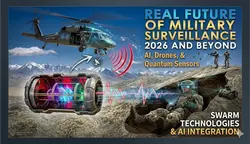
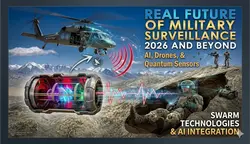
Real Future of Military Surveillance – 2026 and Beyond is advancing rapidly, but not in the way viral stories suggest.
Instead of futuristic systems that can track a human heartbeat from miles away, today’s real breakthroughs rely on artificial intelligence, drone networks, and multi-sensor data fusion.
These technologies work together to track, predict, and locate targets with remarkable accuracy, without breaking the laws of physics.
Stories about futuristic surveillance systems, like tracking a human heartbeat from miles away, capture attention quickly. But how close are we to that reality?
Read More:
In 2026, military surveillance has indeed become incredibly advanced.
However, the real breakthroughs aren’t based on science fiction-style “super sensors.” Instead, they rely on a powerful combination of artificial intelligence, multi-sensor networks, and data fusion.
This article explores real, cutting-edge surveillance technologies being used today—and separates fact from fiction.
The Real Future of Military Surveillance: What Technology Can Actually Do in 2026
1. AI-Powered Multi-Sensor Fusion
The Backbone of Modern Surveillance
The most powerful surveillance capability today isn’t a single device—it’s a system of systems.
Modern military operations combine:
- Satellites
- Drones (UAVs)
- Ground-based sensors
- Signals intelligence (SIGINT)
AI algorithms process this massive data stream to:
- Track movement patterns
- Predict behavior
- Identify individuals based on activity
Why It Matters
Instead of detecting a heartbeat, these systems answer a more important question:
Who are you based on what you do?
This makes them far more accurate and scalable than biological detection methods.
2. Advanced Thermal & Hyperspectral Imaging
Beyond Traditional Infrared
While standard thermal cameras detect heat, newer hyperspectral imaging systems go further.
They can:
- Identify disturbed soil (footprints, digging)
- Detect hidden objects under camouflage
- Differentiate materials based on light reflection
Limitations
- Cannot see through thick rock or deep caves
- Requires line of sight
Despite limitations, these systems are highly effective in open terrain.
3. Ground-Penetrating Radar (GPR) & Through-Wall Detection
Seeing What’s Hidden (to a Degree)
Ground-penetrating radar and similar systems can:
- Detect movement behind walls
- Map shallow underground structures
- Locate tunnels or bunkers
Reality Check – Real Future of Military Surveillance – 2026 and Beyond
- Effective range is limited (meters to hundreds of meters)
- Performance decreases with depth and dense materials
These tools are useful, but far from the idea of scanning miles underground.
4. RF Signal Tracking & Electronic Intelligence
Your Devices Give You Away
Even in stealth scenarios, electronic emissions can expose location.
Military systems can:
- Detect brief phone signals
- Track radio frequency (RF) signatures
- Analyze communication patterns
Key Insight
You don’t need to decode a message, just detecting its existence can reveal position and intent.
5. Biometrics at a Distance – Real Future of Military Surveillance – 2026 and Beyond
Real but Limited Capabilities
Some technologies can identify individuals remotely using:
- Facial recognition
- Gait analysis (how someone walks)
- Short-range heartbeat and breathing detection via radar
Important Limitation
These systems:
- Works best at close range
- Require controlled environments
They are not capable of long-distance biological tracking.
6. Quantum Sensors: The Next Frontier
What’s Real Today
Quantum sensing technologies include:
- Ultra-sensitive magnetometers
- Navigation systems that don’t rely on GPS
- Experimental submarine detection tools
What’s Still Experimental
- Long-range biological detection
- Battlefield deployment at scale
Quantum sensors are promising, but still in early stages for most applications.
7. Persistent Drone Surveillance Networks
Strength in Numbers
Instead of one powerful sensor, modern strategy uses many smaller ones.
Drone swarms provide:
- Continuous area monitoring
- Real-time tracking
- Wide coverage
Advantage
Targets become harder to hide over time, even if they evade detection initially.
8. Acoustic & Seismic Sensors – Real Future of Military Surveillance – 2026 and Beyond
Low-Tech, High Reliability
These systems detect:
- Footsteps
- Vehicle movement
- Underground activity
Often deployed as:
- Hidden ground sensors
- Border monitoring systems
They may not sound advanced, but they are extremely effective.
What a Real Rescue Mission Looks Like
In a real-world scenario involving a downed pilot or hidden target, military forces would likely use:
- Drones with thermal imaging
- Signals intelligence from emergency beacons
- AI-driven pattern analysis
- Ground reconnaissance teams
- Coordinated air support
The Key to Success
Layered intelligence from multiple systems, not a single breakthrough device
Why “Heartbeat Tracking from Miles Away” Isn’t Realistic
Despite compelling narratives, physics imposes hard limits:
- Heartbeat electromagnetic signals are extremely weak
- Signal strength drops rapidly with distance
- Earth’s magnetic field creates overwhelming interference
- Solid rock blocks and distorts signals
Even detecting a heartbeat from a short distance without direct contact is difficult.
The Future of Surveillance
The real direction of military technology is clear:
- More AI integration
- Better sensor fusion
- Autonomous surveillance systems
- Persistent monitoring networks
Not a single “super sensor”, but a smart, connected ecosystem.
Conclusion – Real Future of Military Surveillance – 2026 and Beyond
While stories of advanced technologies like long-range heartbeat tracking are fascinating, the reality is both more practical and more powerful.
Modern surveillance works not by breaking the laws of physics, but by combining data, intelligence, and persistence.
And in many ways, that’s even more effective than science fiction.
Disclaimer/Note: The information above might not be 100% correct. Please verify from your own sources. We will not be responsible for any kind of loss or liability due to our content.
For more news, please visit Munafa Marketing.