
All About New Trump-Class Battleships will definitely be informative if you keep reading till the end.
Imagine building a warship so heavily armed that it carries nearly every weapon system available, missiles, railguns, lasers, aircraft, and sending it into enemy waters to overwhelm opponents through sheer firepower.
Are Modern Battleships Really Coming Back? A Deep Dive Into the “Trump-Class” Warship Concept
That was the philosophy behind battleships a century ago. And now, surprisingly, that idea is being discussed again in modern naval strategy.
According to statements by Donald Trump, a new class of warships, informally referred to as the “Trump-class battleships”, could bring back this concept in a completely modernized form.
But is this a revolutionary idea… or a strategic step backward?
Let’s break it all down.
The Return of Battleships: What’s Being Proposed?
Battleships haven’t played a major role in naval warfare since the Vietnam War. Yet this new proposal aims to revive them—not just in name, but in function.
The lead ship, often referred to as the USS Defiant, is envisioned as:
- Length: 800–880 feet (≈260–270 meters)
- Beam: 105–115 feet (≈32–35 meters)
- Displacement: ~35,000 metric tons
That puts it closer in size to amphibious assault ships like the America-class amphibious assault ship than traditional destroyers.
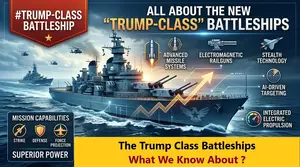
Interestingly, aesthetics are also part of the design. Trump reportedly emphasized that the ship should look “sleek” and visually appealing, criticizing modern stealth ships as unnecessarily “ugly.”
More Than a Ship: A Floating Arsenal
The defining idea behind this concept is simple: maximum firepower.
Instead of specializing, this battleship would combine multiple advanced weapon systems into one platform.
Primary Weapons System – All About New Trump-Class Battleships
1. Nuclear-Capable Cruise Missiles (SLCM-N)
The proposed Sea-Launched Cruise Missile Nuclear (SLCM-N) system is a revival of Cold War-era capabilities.
- Based on earlier nuclear variants of the Tomahawk missile
- Previously removed after a 1991 decision by George H. W. Bush
- Officially retired in 2013
Now, the idea is to bring back a non-strategic nuclear option at sea, potentially with a new warhead design and a range of several thousand kilometers.
This effectively brings U.S. naval strategy full circle to the 1980s.
2. Hypersonic Missile Systems
The ship would also carry Conventional Prompt Strike (CPS) hypersonic missiles.
These weapons:
- Travel faster than Mach 5
- Are highly maneuverable
- Can strike targets globally within an hour
Some estimates suggest they could replace nuclear weapons for up to 30% of mission scenarios, offering precision without escalation.
3. Vertical Launch System (VLS)
The ship would include 128 VLS cells, capable of launching:
- Surface-to-air missiles
- Anti-ship weapons
- Anti-submarine systems
- Tactical strike missiles
However, this is where criticism begins.
For a 35,000-ton ship, 128 cells is considered inefficient, especially compared to the Ticonderoga-class cruiser, which carries 122 VLS cells at a fraction of the size.
Bottom line: More size doesn’t equal more efficiency.
Secondary Weapons: Advanced but Problematic – All About New Trump-Class Battleships
Railgun Technology
A major highlight is the proposed 32-megajoule railgun.
Advantages:
- Fires projectiles at extreme speeds (up to Mach 9)
- No explosive ammunition required
- Safer storage onboard
Major Challenges:
- Extreme heat generation (can melt components)
- Very high maintenance requirements
- Limited firing rate due to cooling needs
- Barrel degradation after limited use
- Still not fully operational after decades of research
Even more concerning:
Its range (~110 nautical miles) is shorter than modern missile systems, forcing the ship into dangerous proximity with enemy weapons.
Conventional Naval Guns
The ship would also carry Mark 45 5-inch guns, which:
- Fire 70-pound shells
- Have a range of ~20 nautical miles
- Can fire 16–20 rounds per minute
These are cost-effective and useful for:
- Close-range defense
- Shore bombardment during amphibious operations
Laser Weapons
Laser systems are another futuristic addition.
Benefits:
- No physical ammunition
- Extremely low cost per shot
- Effective against drones and missiles
Limitations:
- Short range (line-of-sight only)
- Reduced effectiveness in bad weather
- Limited ability to penetrate armor
Additionally, systems like ODIN (Optical Dazzling Interdictor Navy) are designed to disrupt enemy sensors, not destroy targets.
Air Capabilities and Unmanned Systems – All About New Trump-Class Battleships
The ship would support aircraft such as:
- Bell Boeing V-22 Osprey
- Future Vertical Lift (FVL) helicopters
It would also act as a command hub for unmanned systems, including:
- Drones
- Autonomous ships
- Unmanned submarines
By 2050, some projections suggest up to one-third of military assets could be unmanned, making this capability highly relevant.
The Power Problem: A Critical Flaw
One of the most controversial decisions is the use of conventional (fossil fuel) propulsion instead of nuclear power.
Why this matters:
- Railguns and lasers require massive energy
- Conventional engines require frequent refueling
- Refueling creates logistical vulnerabilities
If supply ships are destroyed, the battleship becomes immobile and ineffective.
In contrast, nuclear-powered ships like the USS Gerald R. Ford:
- Have near-unlimited range
- Require less frequent maintenance
- Can sustain high power output
Why Battleships Disappeared in the First Place
To understand the criticism, we need to look at history.
The Last Battleship Era
Ships like the USS Missouri represented peak battleship design.
They featured:
- Massive guns (16-inch cannons)
- Heavy armor (up to 16 inches thick)
- Large crews (~2,700 sailors)
They were essentially pre-nuclear superweapons.
What Replaced Them?1. Nuclear Weapons
The bombings of Hiroshima bombing and Nagasaki bombing changed warfare forever.
2. Aircraft Carriers
Mobile air power replaced big guns.
3. Guided Missiles
More accurate, longer-range, and more cost-effective than artillery.
The Core Issue: Centralization vs Modern Warfare
Modern naval doctrine emphasizes decentralization.
Instead of one massive ship, navies use:
- Multiple destroyers
- Submarines
- Carrier strike groups
Why?
Because putting everything on one ship:
- Creates a massive target
- Risks losing everything in one strike
This is the biggest weakness of the battleship concept.
The Arsenal Ship Comparison
The proposed design closely resembles the arsenal ship concept from the Cold War.
These ships would:
- Carry hundreds of missiles
- Act purely as offensive platforms
But they were never built, because:
- They were too vulnerable
- Too expensive
- Too risky
Modern submarines now fulfill this role more effectively due to stealth.
The Strategic Debate: Replace Destroyers?
One of the biggest concerns is that this concept could replace the next-generation destroyer program.
That program aims to:
- Improve upon existing destroyers
- Incorporate lessons from past designs
- Provide balanced, flexible capabilities
Compared to that, the battleship concept:
- Lacks detailed development
- Has no proven viability
- Would take over a decade to build
Cost and Practicality
Estimated cost:
- Next-gen destroyer: ~$2.8 billion
- Battleship (larger): significantly more
And unlike destroyers, the battleship:
- Concentrates risk
- Offers questionable efficiency
- Relies on unproven technologies
Why Push for It? All About New Trump-Class Battleships
There are several possible reasons:
1. Personal Preference
Trump has openly expressed admiration for battleships and their WWII performance.
2. Symbolic Power
A massive warship projects strength, politically and militarily.
3. Naming Legacy
Naming a ship class after a sitting president would be historically unusual.
Will It Actually Happen?
As of now:
- The battleship concept remains a proposal
- The destroyer program is still ongoing
- No final decision has been made
Even if approved, it would take at least a decade before the first ship is operational.
Final Verdict: Future or Fantasy?
The idea of a modern battleship is undeniably fascinating. A single ship packed with cutting-edge weapons sounds powerful on paper.
But modern warfare isn’t about maximum firepower in one place.
It’s about:
- Flexibility
- Survivability
- Distributed القوة (power)
And by those standards, the battleship concept struggles to justify itself.
In reality, the future of naval warfare lies not in reviving the giants of the past, but in smarter, more adaptable systems designed for modern threats.
Disclaimer/Note: The information above might not be 100% correct. Please verify from your own sources. We will not be responsible for any kind of loss or liability due to our content.
For more news, please visit Munafa Marketing.