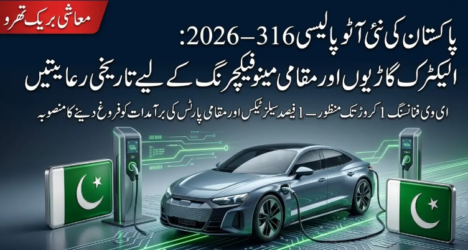
Pakistan Auto Policy 2026–31 – Key Features, reaches final cabinet approval. Explore key features, EV financing up to Rs10 million, 1% sales tax for NEVs, and localization targets.
Executive Summary
- Policy Milestone: The proposed Automotive and Auto Parts Manufacturing Policy (AIDEP 2026–31) has entered its final approval phase, laying down the direction for Pakistan’s auto sector over the next 5 years.
- Aggressive Electrification Push: Establishes a 1% sales tax rate for qualifying New Energy Vehicles (NEVs) along with a 1% customs duty on imported EV charging infrastructure.
- Higher EV Financing Limits: Expands auto financing limits for New Energy Vehicles from Rs. 3 million to Rs. 10 million with an extended repayment tenor of up to 5 years.
- Localization & Export Tariffs: Incentives are directly tied to local content assembly and mandatory component export targets, projecting over $17.7 billion in cumulative forex savings.
- Used Car Import Overhaul: Introduces mandatory inspection requirements for imported used vehicles alongside a 30% additional duty, scheduled to phase down to zero over four years.
Core Architectural Pillars: Auto Policy 2026–2031
The new 5-year framework shifts the government’s approach from passive tariff protection to measurable local value addition, export-linked manufacturing, and rapid adoption of green transport.
- Electric & New Energy Vehicle Acceleration: Grants tax relief to zero-emission and low-emission platforms, establishing separate tax treatments for pure EVs, Plug-in Hybrids (PHEVs), and Range-Extended Electric Vehicles (REEVs).
- Vendor & Local Parts Development: Introduces the Vendor Upgradation and Technology Transfer Programme (VUTTP) to modernize PAAPAM member workshops and develop local component clusters.
- Adoption of UNECE Safety Standards: Enforces 45 international UNECE vehicle safety regulations and mandates the establishment of the Pakistan Automotive Testing Institute.
- Contract Manufacturing Allowance: Permits existing assemblers to share unused factory capacity with incoming global brands to optimize local overhead costs.
Comprehensive Feature Matrix & Tax Framework
The AIDEP 2026–31 framework restructures duties, consumer credit, and manufacturing mandates across the entire automotive value chain:
Core Policy Features – Pakistan Auto Policy 2026–31 – Key Features
- 1% NEV Sales Tax Rate: Reduced sales tax structure applied specifically to qualifying locally assembled New Energy Vehicles.
- Infrastructure Tax Reduction: Flat 1% customs duty imposed on imported EV charging stations, fast-chargers, and battery-swapping modules.
- Rs. 10 Million EV Credit Limit: Enhanced auto loan cap for green vehicles, allowing buyers up to 5-year repayment tenors via commercial banks.
- Phased Duty Reductions: Progressive elimination of regulatory duties (RD) and additional customs duties (ACD) on CKD kits by FY2031.
- Contract Assembly Guidelines: Legalized framework allowing established manufacturing plants to produce vehicles under contract for new entrant brands.
Benefits for Consumers & National Economy – Pakistan Auto Policy 2026–31 – Key Features
- Cheaper Domestic EV Adoption: Lowers the entry cost of ownership for electric and plug-in hybrid cars through tax relief and extended bank financing.
- Massive Foreign Exchange Savings: Expected to save $17.7 billion in foreign exchange reserves over 5 years by substituting imported CBU cars with localized CKD assembly.
- Stronger Vehicle Safety: Guarantees higher structural build quality and mandatory safety features through UNECE international testing compliance.
- Growth in Local Jobs: Boosts employment across auto-vendor networks in Lahore, Karachi, and Faisalabad by linking tax breaks directly to local parts production.
Frequently Asked Questions (FAQs) – Pakistan Auto Policy 2026–31 – Key Features
Here are the FAQs regarding Pakistan Auto Policy 2026–31 – Key Features:
Q1: What is the main goal of Pakistan’s Auto Policy 2026–2031?
Ans. The policy aims to transition Pakistan’s automotive industry toward high localization, export-oriented manufacturing, international safety compliance, and widespread adoption of New Energy Vehicles (NEVs).
Q2: How does the new auto policy support electric vehicle financing?
Ans. The framework increases the maximum bank financing limit for NEVs from Rs. 3 million to Rs. 10 million and extends the maximum loan tenure to 5 years.
Q3: Will conventional hybrid cars get the same tax relief as electric vehicles?
Ans. No, conventional hybrid vehicles are treated separately under the tax structure, while pure electric vehicles, REEVs, and PHEVs qualify for primary NEV tax incentives such as the 1% sales tax rate.
The Bottom Line – Pakistan Auto Policy 2026–31 – Key Features
The Auto Policy 2026–2031 represents a decisive transition for Pakistan’s industrial landscape. By shifting financial incentives away from unlocalized assembly toward export-linked localization, EV infrastructure growth, and international safety compliance, the government is positioning the local automotive market to be more competitive, sustainable, and consumer-friendly over the next five years.
Pakistan Auto Policy 2026–31 – Key Features, reaches final cabinet approval. Explore key features, EV financing up to Rs10 million, 1% sales tax for NEVs, and localization targets.
Disclaimer/Note: The information above might not be 100% correct. Please verify from your own sources. We will not be responsible for any kind of loss or liability due to our content.
For more news, please visit Munafa Marketing.